Ningishzida: The Serpent Lord Behind the Caduceus
A man in mourning clothes stands at the gate of heaven, and two gods block his way. That scene, preserved on Akkadian tablet fragments dug from El-Amarna and Nineveh, is one of the strangest job records in ancient religion, because one of the two gatekeepers is Ningishzida, the serpent lord of Sumer. His resume reads like several gods stapled together: personal deity of a temple-building king, gatekeeper of Anu's heaven, underworld throne bearer, healer's son, and a vegetation god mourned every year as 'carried off to the underworld.' His personal emblem, two serpents twined around a staff on a stone vase carved around 2100 BCE, is the earliest image of its kind anywhere in the archaeological record, more than 1,500 years before the Greek caduceus. This is the dossier on the serpent lord himself: the 1,363-line clay cylinders that call him 'my god,' the offering lists and personal names that prove a living cult, the seals that draw him with serpents rising from his shoulders, the honest admission that his fame is partly an accident of preservation, and the hard Tier 4 verdicts on the DNA-helix and Ancient Astronaut readings that keep trying to claim him. One question waits at the gate: which gods get remembered, and why?
A man stands at the gate of heaven, dressed in mourning. His name is Adapa, the wise sage of Eridu, servant of the god Enki, and he has been summoned to the sky to answer for breaking the wing of the South Wind. Before he can face the sky god Anu, he has to get past the gate, and the gate has keepers. Two gods look the mourner over and question him. One is Tammuz, Mesopotamia's famous dying god. The other is the subject of this file: Ningishzida, the serpent lord of Sumer, whose personal emblem, carved in stone around 2100 BCE, is the oldest image of intertwined serpents on a central axis anywhere in the archaeological record, more than 1,500 years before Hermes ever carried a caduceus.
01The Gate of Anu
The scene comes from 'Adapa and the South Wind,' an Akkadian text pieced together from fragments found at El-Amarna in Egypt and Nineveh in Assyria. Adapa, the wise sage of Eridu and servant of Enki, called Ea in Akkadian, breaks the wing of the South Wind and is summoned before the sky god Anu to answer for it. And at the gate of Anu's heaven stand two gatekeepers, questioning him: Ningishzida and Tammuz.
The text preserves their question to him word for word, at lines 44 to 48 of version B: 'Man, for whom do you look like this? Adapa, why are you dressed in mourning?' It reads like a checkpoint, two officials at a border, sizing up a traveler who does not belong.
Then the gatekeepers do something no demonized serpent would ever be scripted to do: they take the mortal's side. Ningishzida and Tammuz intercede on Adapa's behalf before Anu, presenting him as a worthy sage.
The research file draws three conclusions from the scene, all sitting on the text itself. Ningishzida is a liminal deity, standing between heaven and earth. He is a figure associated with sages and wisdom. And he is paired with Tammuz, called Dumuzi in Sumerian, as complementary underworld and gate deities. Keep that job description in mind, gatekeeper, wisdom-adjacent, advocate for the worthy, because everything else in this file hangs on it.
02The God With Receipts
First, the identity card. Ningishzida, Sumerian dNin-gis-zid-da, means 'Lord of the Good Tree' or 'Lord of the Faithful Tree,' and he is a Mesopotamian deity associated with serpents, the underworld, vegetation, and secret knowledge. He appears in Sumerian texts from at least the Ur III period, about 2112 to 2004 BCE, and is featured most prominently in the Gudea Cylinders of Lagash, about 2144 to 2124 BCE, where he serves as the personal deity, the dingir, of the city's ruler, the ensi Gudea.
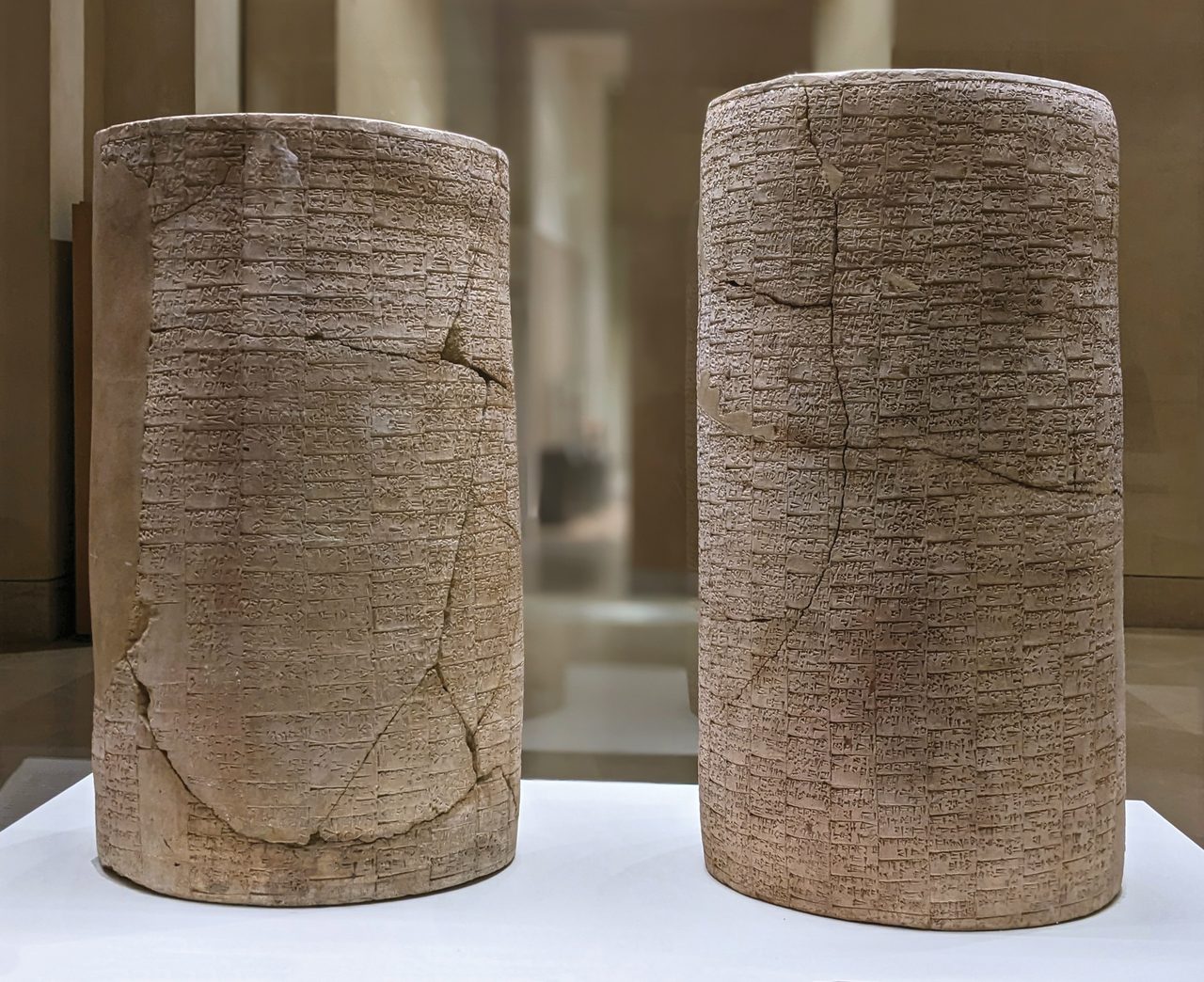
The Gudea Cylinders are not a footnote source. Cylinders A and B, two large clay cylinders now held in the Louvre, carry about 1,363 lines of Sumerian, the longest Sumerian literary text known. And in that text, the ruler of Lagash names his god in the first person: 'Ningishzida is my god,' Cylinder A, column iii, line 6. The phrase he uses is dingir-mu, 'my god.'
The cylinders record how Gudea received his temple-building instructions in a dream vision, interpreted for him by the goddess Nanshe, with Ningishzida appearing as an intermediary deity facilitating the divine communication. The project itself, the Eninnu, the 'House of Fifty,' was built for Ningirsu, the chief deity of Lagash. Read the roles precisely: Ningishzida is not the temple's dedicatee. He is Gudea's divine patron and intercessor inside the project, the god who walks his human into the room, which is exactly the role he plays at Anu's gate.
He is also in the official paperwork of Mesopotamian religion. The Weidner God List, an Old Babylonian compilation from around 1800 BCE, places Ningishzida among the underworld deities. The canonical An = Anum god list of the first millennium BCE goes further, listing him with his own court, his spouse Azimua, and his associated deities.
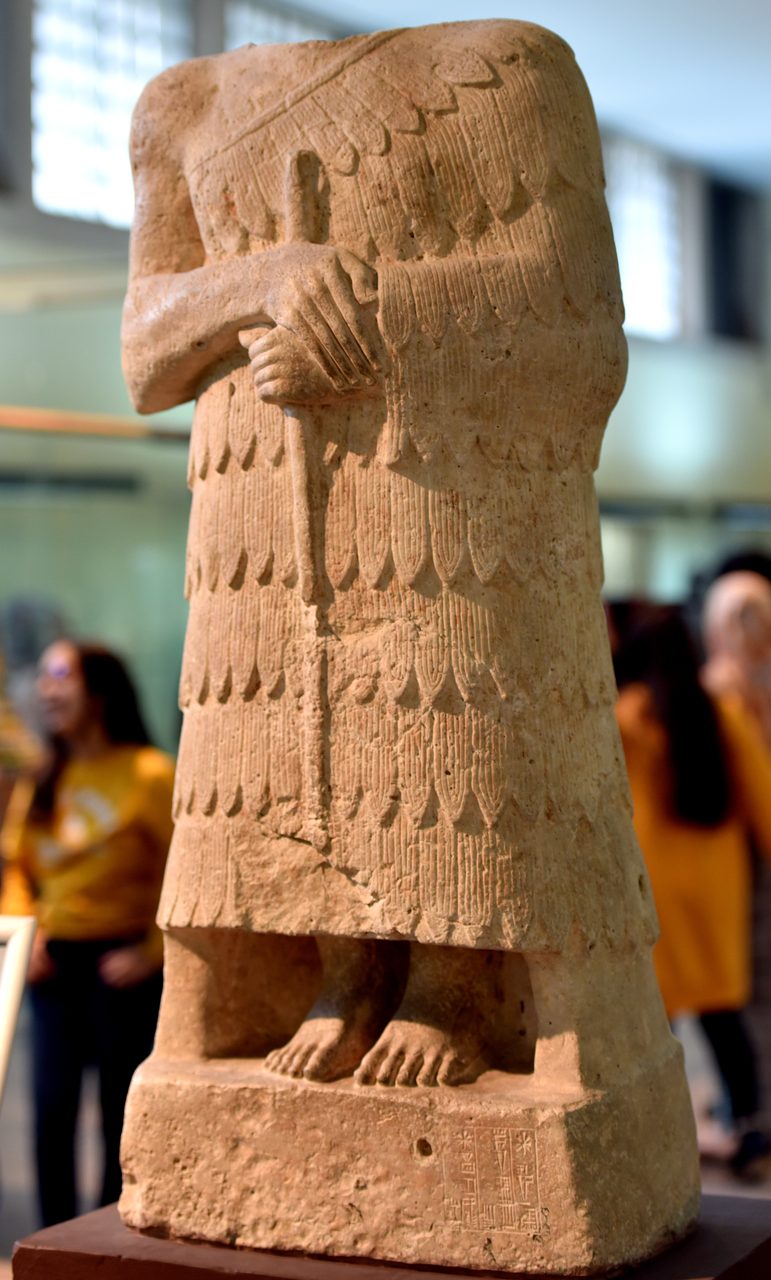
And beneath the literature sits the economics. Offering lists from Ur III administrative archives show Ningishzida receiving regular offerings at Girsu and Lagash, bureaucratic receipts for an active cult, not just a literary tradition. Ordinary people carried him in their own names, too: theophoric personal names like Ur-Ningishzida, 'Servant of Ningishzida,' and Lu-Ningishzida, 'Man of Ningishzida,' appear in Ur III and Old Babylonian texts. When parents name their children after a god, the god is not a metaphor.
03The God Who Dies With the Grass
Then there is the other side of the gatekeeper: the god who dies. A Sumerian lament known as 'In the Desert by the Early Grass,' attested from the Ur III to Old Babylonian periods, mourns Ningishzida's descent to the underworld: 'the lord has been carried off to the underworld... Ningishzida has been carried off to the underworld.' The research file is straight about the state of the evidence, and so are we: the text is genuinely attested but fragmentary, which is why this claim wears Tier 2 rather than Tier 1.
What the lament describes is a recognizable type. Like Tammuz, Ningishzida is read as a dying-and-rising vegetation deity whose descent to the underworld correlates with seasonal death, placing him in the same typological category as Tammuz, Osiris, Baal, and Adonis: the ancient Near Eastern dying-god pattern. The dying-god interpretation itself is scholarly consensus. A serpent god who dies with the grass and returns with it, and who also keeps the door of heaven: Sumer saw no contradiction in that resume.
04The Family Plot
The genealogy deepens the pattern. His father is Ninazu, an underworld deity whose name means 'Lord Healer,' suggesting a healing and medical lineage running through the family. His spouse is Azimua, a minor underworld goddess. His documented associations run: serpents, the underworld, vegetation, healing, hidden knowledge, and, in some traditions, the number 60. The relationships are documented in god lists, though some details vary, which is why the file carries the genealogy at Tier 2.
Notice where the family tree puts him. Ningishzida sits firmly in the chthonic, underworld tier of the divine hierarchy, among the attendants and mediators, not among the great cosmic gods like Anu, Enlil, and Enki. He is middle management in the Mesopotamian divine bureaucracy. Hold that thought, because the file's most honest finding, further down, depends on it.
05Eight Jobs for One God
Pull all of it together and Ningishzida turns out to hold one of the busiest portfolios in Sumerian religion. The research file tabulates eight documented functions, and rather than forcing them into the numeric tier system, it rates each on its own confidence scale, High or Moderate. The table below carries the file's own ratings, unchanged.
| Function | The Evidence | The File's Confidence |
|---|---|---|
| Personal Deity, Patron God | The Gudea Cylinders | High |
| Gatekeeper of Heaven | The Adapa myth | High |
| Underworld Deity | God lists, the descent lament, the genealogy | High |
| Vegetation, Dying God | The descent lament, the seasonal parallel | Moderate |
| Serpent Deity | The iconography | High |
| Healer | Father Ninazu, 'Lord Healer,' and the serpent-medical association | Moderate |
| Knowledge, Wisdom Bearer | The Adapa intercession; personal god of the learned Gudea | Moderate |
| Throne Bearer | An = Anum names him 'one who carries the throne' of the underworld | Moderate |
06The Serpent in the Seals
How did Sumer picture him? The cylinder seals answer, and the answer is stranger than a snake. Multiple Ur III and Old Babylonian seals show Ningishzida as a serpent-bodied deity, or as a human figure flanked by serpents, and some draw him as a full hybrid: a human upper body with a serpent lower body, or serpent heads rising from his shoulders, the 'serpent-horned' iconographic type. Francoise Demange, in the Louvre catalog, and Edith Porada, of Columbia University, have published typologies of his seal imagery. This is not one artist's flourish. It is a repeated, classifiable iconographic identity.
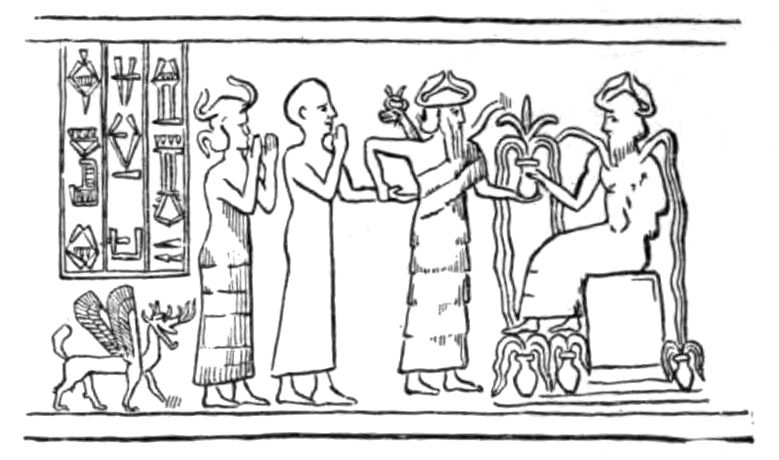
His most famous image needs only a brief stop here, because it already has its own dossier. The steatite libation vase of Gudea, Louvre AO 22126, carved around 2144 to 2124 BCE and inscribed with a dedication to Ningishzida, shows two intertwined serpents wrapped around a central staff, flanked by two winged serpent-dragons: the earliest known image of intertwined serpents on a central axis in the archaeological record, predating the Greek caduceus by more than 1,500 years. The vase, the Louvre catalog identification, and the full caduceus argument are told in depth in our Enki and Enlil dossier, and we are not re-litigating them here.
One tier note travels with that emblem wherever it goes. The iconographic lineage from Ningishzida's intertwined serpents to the Greek caduceus is plausible, and it is widely noted by art historians, but it is not proven as a direct transmission. The gap is roughly 1,600 years, and the intermediary links are sparse. A credible line of descent, not a demonstrated one.
07The Serpent-Knowledge Nexus
Why serpents at all? The file's answer is a pattern it calls the serpent-knowledge nexus, and Ningishzida embodies every clause of it. Serpents live underground, where hidden things are: knowledge of the unseen. They shed their skin: renewal and immortality. They guard sacred spaces: the gatekeeper function. And they coil around an axis: the connection between worlds. The same cluster surfaces in the Genesis 3 serpent, in the Indian Naga wisdom guardians, in the Greek oracle serpent Python, and in the Egyptian Nehebkau, the serpent who binds the ka souls, a parallel we draw in full in Wadjet, the Cobra Goddess. The pattern itself is well-documented. Whether it amounts to a single unified tradition is debated, and this file does not pretend otherwise.
The research file also scores the famous one-to-one comparisons, on its own strength-of-connection scale rather than the numeric tiers, and the scores are deliberately cold. Hermes and his caduceus rate Moderate: an iconographic parallel with no textual link. Asclepius and his healing serpent rate Moderate: a shared medical serpent tradition. Thoth of Egypt rates Weak: a parallel knowledge-bearer function with no proven contact. And Quetzalcoatl, the feathered serpent of Mesoamerica, rates None: a geographic and chronological gulf no evidence crosses. The full cross-cultural survey of the world's serpent gods is its own dossier in this wing, and the wider pattern gets weighed there, on its own terms.
08The Ladder Down
Now the speculative shelf, labeled the way the file labels it. Tier 3: the serpent coiled around a central axis has been compared to the Hindu kundalini, the serpent energy said to rise through the spine's central channel, the sushumna. The symbolic parallel is real, serpent plus axis on both sides, but no cultural transmission between Sumer and Vedic India has been demonstrated for this specific concept. The file's own flag: a symbolic parallel exists, a direct connection is undemonstrated. Discussable, open, and load-bearing for nothing.
Tier 4, first entry: the DNA reading. Jeremy Narby's The Cosmic Serpent (1998) and a shelf of popular writers have compared the intertwined serpents on the Gudea vase to the DNA double helix. The file's verdict is not gentle, and ours matches it: no credible archaeological or textual evidence supports this, and the interpretation has zero support in Sumerological scholarship. A Sumerian stone carver around 2100 BCE was not drawing nucleotides.
Tier 4, second entry: the Ancient Astronaut reading. Zecharia Sitchin's The 12th Planet (1976) cast Ningishzida as 'Thoth' inside his Anunnaki construct. The identification relies on selective mistranslation of Sumerian and has been rejected by all credentialed Sumerologists. The file flags the whole approach as based on discredited methodology, and this article rules it out with it.
09The Honest File
Here is where this research file earns its keep, because it turns its skepticism on itself. First caution, carried under the file's own label of valid scholarly caution: serpent imagery is so widespread across ancient cultures that parallel serpent symbolism does not, by itself, demonstrate contact or a shared tradition. Serpents were universally encountered animals with universally striking characteristics: they shed, they envenom, they live underground. The gap between the Gudea vase, around 2100 BCE, and the Greek caduceus of the 5th century BCE is over 1,600 years, and the intervening iconographic evidence is sparse. And Frans Wiggermann, in 'Transtigridian Snake Gods' (1997), pressed the point further: Mesopotamian serpent symbolism served multiple unrelated functions, guardian, demon, fertility, chaos, and should not be reduced to a single serpent-equals-knowledge equation.
Second caution, and it is the bravest line in the file. Ningishzida is genuine, well-attested, and important, and he was also a regional deity of moderate rank: not Enki, not Enlil, not Marduk, not Ishtar. His modern prominence is partly an artifact of preservation. The Gudea Cylinders and the Gudea vase survived in exceptional condition, and if they had been lost, he would be known today primarily from entries in god lists. The scholarly literature on serpent symbolism, the file admits, tends to treat Ningishzida as more central than the Sumerian evidence warrants, because his iconography conveniently matches modern symbolic interests. In plain terms: we did not remember the god. We remembered the artifact, and rebuilt the god around it.
Fast Facts
- The God
- Ningishzida, 'Lord of the Good Tree' or 'Lord of the Faithful Tree': a Mesopotamian deity of serpents, the underworld, vegetation, and secret knowledge, in texts from at least the Ur III period, about 2112 to 2004 BCE.
- The Gate
- In 'Adapa and the South Wind,' Ningishzida and Tammuz keep the gate of Anu's heaven, question the sage Adapa, then intercede for him before Anu: the serpent god as advocate, not adversary.
- The Text
- The Gudea Cylinders, about 1,363 lines on two clay cylinders in the Louvre, the longest Sumerian literary text known. In it, the ruler of Lagash says it plainly: 'Ningishzida is my god.'
- The Descent
- The lament 'In the Desert by the Early Grass' mourns him carried off to the underworld: a dying-and-rising vegetation god of the same type as Tammuz, Osiris, Baal, and Adonis. Attested but fragmentary, so it wears Tier 2.
- The Emblem
- His symbol on the Gudea libation vase, around 2100 BCE, is the earliest known image of intertwined serpents on a central axis, more than 1,500 years before the Greek caduceus. The lineage to the caduceus: plausible, widely noted, unproven.
- The Rank
- By the file's own honest assessment, a regional deity of moderate rank whose modern fame is partly an artifact of what happened to survive: the Gudea materials.
- Ruled Out
- The DNA double-helix reading of the vase and Sitchin's Ancient Astronaut identification of Ningishzida as 'Thoth.' The research file flags both at Tier 4.
- The Open Question
- A moderate-rank gatekeeper god outlived Sumer by four thousand years. Which gods get remembered, and why?
What the Evidence Actually Holds
The textual and archaeological core holds. Ningishzida is named in Sumerian texts from at least the Ur III period. The Gudea Cylinders, about 1,363 lines in the Louvre and the longest Sumerian literary text known, record 'Ningishzida is my god' at Cylinder A, column iii, line 6, and cast him as intermediary in Gudea's dream-vision temple project for Ningirsu. The Weidner God List and the canonical An = Anum place him among the underworld deities with his court and his spouse Azimua. Ur III offering lists at Girsu and Lagash show a real, funded cult, and theophoric names like Ur-Ningishzida show real worshippers. In 'Adapa and the South Wind,' known from fragments found at El-Amarna and Nineveh, he stands with Tammuz as gatekeeper of Anu's heaven, questions Adapa in lines the text preserves verbatim, and intercedes for him. Cylinder seals repeatedly draw him serpent-bodied or serpent-hybrid, per the published typologies of Demange and Porada. And the Gudea libation vase dedicated to him carries the earliest known image of intertwined serpents on a central axis.
The interpretive layer is credible and travels with its hedges attached. The dying-and-rising vegetation-god reading of 'In the Desert by the Early Grass' is scholarly consensus, but the lament itself is fragmentary. The genealogy, father Ninazu the 'Lord Healer,' spouse Azimua, is documented in god lists with details that vary. His placement in the chthonic mid-tier of the pantheon, mediator rather than cosmic god, is solid. The caduceus lineage is plausible and widely noted by art historians but unproven as direct transmission, across a gap of more than 1,600 years with sparse intermediaries. The serpent-knowledge nexus is a well-documented pattern whose reading as one unified tradition is debated. And the file's own self-limits sit at this tier: Wiggermann's caution that Mesopotamian serpent symbolism served multiple unrelated functions and resists any single equation, and the honest admission that Ningishzida was a regional deity of moderate rank whose modern prominence partly reflects the lucky preservation of the Gudea materials.
One idea stays speculative and is labeled that way by the research file itself: the kundalini parallel, serpent plus central axis in both Sumer and India, with no demonstrated cultural transmission between them for this specific concept. Discussable, unproven, and load-bearing for nothing above.
Ruled out, explicitly. The intertwined serpents on the Gudea vase are not a depiction of the DNA double helix: Narby's reading has no credible archaeological or textual evidence behind it and zero support in Sumerological scholarship. And Sitchin's Ancient Astronaut identification of Ningishzida as 'Thoth' rests on selective mistranslation of Sumerian and discredited methodology, rejected by all credentialed Sumerologists. The research file flags both as claims to avoid stating as fact, and this article rules them out with it.
So stand in the Louvre, where two clay cylinders carry the longest text Sumer ever left us, and read the job description of a god nobody prays to anymore. Gatekeeper of heaven. Underworld throne bearer. Patron of a temple-building king. A healer's son who died with the grass, mourned in a lament we can still read, and who stood at the door of the sky to speak up for a mortal in mourning clothes. The file's most honest line is also its sharpest: he was a regional god of moderate rank, and we only know him this well because his king's cylinders and his stone vase happened to survive. Yet survive they did. His emblem outlived Sumer by four thousand years, and if the art historians are right about the caduceus, it may still be on duty, carried by the doctors and the messengers, at the doors between one world and the next. So the question this file leaves standing at the gate: which gods get remembered, and why, and how much of what we call memory is just what the ground decided to keep?
Sources & further reading
Everything above is drawn from our research library on Theories of Anything, and every claim traces back to the files below. The primary file is the Ningishzida dossier itself, B_1_04, which carries the Adapa gatekeeper material, the Gudea Cylinder record, the eight-function table, the seal typologies, and its own honest self-limits, quoted throughout this article. Its scholarship runs through Jacobsen's The Harps That Once (1987), Edzard's Gudea and His Dynasty (1997), Suter's Gudea's Temple Building (2000), van Buren's The God Ningizzida (1934), Izre'el's Adapa and the South Wind (2001), Dalley's Myths from Mesopotamia (1989), Porada's Pierpont Morgan seal corpus (1947), Wiggermann's Mesopotamian Protective Spirits (1992) and Transtigridian Snake Gods (1997), Lambert's The Theology of Death (1980), and Katz's The Image of the Netherworld in the Sumerian Sources (2003), with Narby and Sitchin cited only as the subjects of the file's own Tier 4 critique. The sibling files below hold the Sumerian literary context, the sage tradition behind Adapa, the parallel dying god, the divine knowledge systems, the Naga parallels, and the speculative readings at their own tiers. Open the full files to check the sourcing and go further.
Image credits
- Cylinders A and B of Gudea, circa 2144-2124 BCE, Louvre Museum photograph by Shonagon, via Wikimedia Commons. CC0 1.0 Source.
- Seal of Gudea, led by Ningishzida, line-drawing reproduction, from William Hayes Ward's The Seal Cylinders of Western Asia (1910) via Wikimedia Commons. Public domain Source.
- Headless votive statue dedicated to Ningishzida, circa 2600-2370 BCE, Iraq Museum photograph by Osama Shukir Muhammed Amin FRCP(Glasg), via Wikimedia Commons. CC BY-SA 4.0 Source.
- Card crop of Cylinders A and B of Gudea, circa 2144-2124 BCE, Louvre Museum photograph by Shonagon, via Wikimedia Commons. CC0 1.0 Source.


