The Galileo Project: Science Points a Telescope at UAP
Every UAP argument dies at the same wall. A video can tell you an object looked strange and nothing else: not how far away it was, not how large, not how fast. In July 2021 a Harvard astronomer stopped arguing about footage and started building instruments instead, privately funded, and committed to publishing what came out. The first results from that instrument landed in January 2025, and it is a measurement of the telescope rather than a discovery about the sky. This dossier keeps three things apart on purpose: what the Galileo Project has actually put through peer review, what its press material claimed, and what other scientists said back. On the spherules dredged off Papua New Guinea, both sides are here at full strength and nobody gets crowned.
Every argument about UAP hits the same wall. Somebody has a video. Nobody can say how far away the object was, how large it was, or how fast it moved, because a phone camera and a gun camera both record angles, not distances. The research file behind this dossier opens on exactly that gap: there has never been much systematic, calibrated, multi-sensor observation of anomalous aerial phenomena, only witnesses and clips. In July 2021 a Harvard astronomer stopped arguing about the clips and went to build the instrument.
This dossier is the instrument, not the phenomenon, and it keeps three things apart on purpose: what the Galileo Project has actually put through peer review, what its press material claimed, and what other scientists said back. Those are different classes of evidence and the difference is the whole story. Individual cases live elsewhere. The Nimitz Tic-Tac has its own file, the Norwegian valley that has been under scientific study since 1983 is covered in Window Areas, and the vocabulary is in UAP 101.
01The Reason Your Video Cannot Settle It
Our research file tags one popular belief [CONTRADICTED BY METHODOLOGY], and it is the most useful line in the document: the claim that citizen videos are sufficient evidence. Uncalibrated smartphone and security-camera footage, however strange it looks, cannot supply the quantities a physical analysis needs, which are range, speed, size and spectral characteristics. Purpose-built calibrated systems are essential. That is not a snub aimed at witnesses. It is a statement about what a single uncalibrated sensor can and cannot measure.
There is a worked example of how hard the honest version is. In 2019 Kevin H. Knuth, Robert M. Powell and Peter A. Reali published 'Estimating Flight Characteristics of Anomalous Unidentified Aerial Vehicles' in Entropy. Extracting flight characteristics at all required calibrated multi-sensor data, and even then the estimates carried wide uncertainty. That is the standard the field is measured against, and almost nothing in the public record meets it.
So the interesting question stopped being what people saw. It became whether anybody would build the machine that could settle it.
02What Loeb Actually Built
The Galileo Project was announced on 26 July 2021 with 1.755 million US dollars in private donations, subsequently expanded. Its co-founder and donor was Frank H. Laukien, whom Scientific American described as a chemist and entrepreneur and whose own company's investor releases name him as Chairman, President and CEO of Bruker Corporation. The funding is private, and the point of it was to generate new calibrated data rather than argue about somebody else's footage.
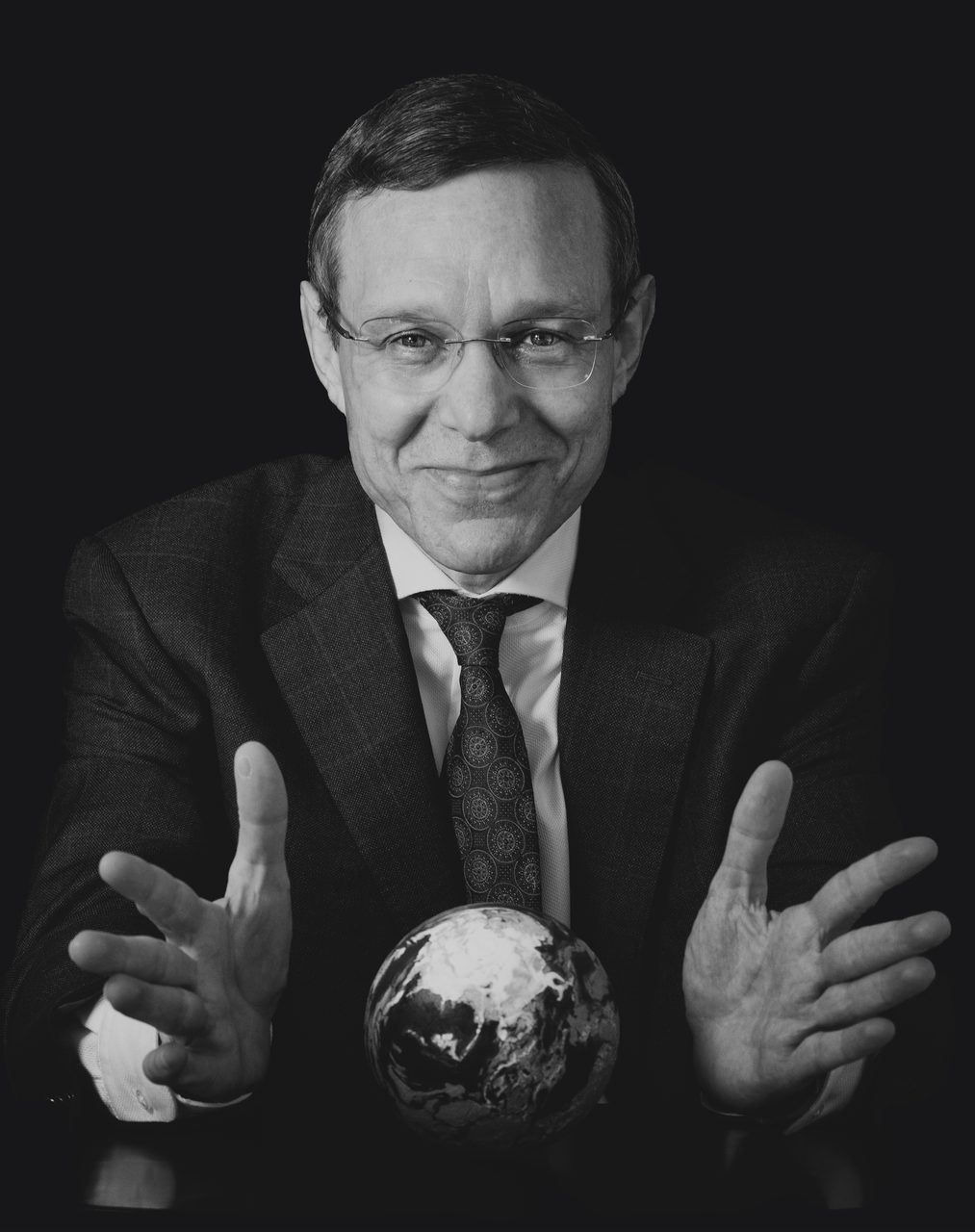
The man behind it is not a fringe outsider, and pretending otherwise makes the rest of the story unreadable. Avi Loeb is the Frank B. Baird, Jr., Professor of Science at Harvard University. He chaired Harvard's Department of Astronomy from 2011 to 2020, was founding director of Harvard's Black Hole Initiative from 2016 to 2021, and directs the Institute for Theory and Computation at the Harvard-Smithsonian Center for Astrophysics. He is an elected fellow of the American Academy of Arts and Sciences and of the American Physical Society. Two things this dossier will not print: a book or paper count, because the two Harvard-hosted pages that carry those numbers disagree with each other, and the phrase longest-serving, because that is his own description of himself and we could not confirm it independently.
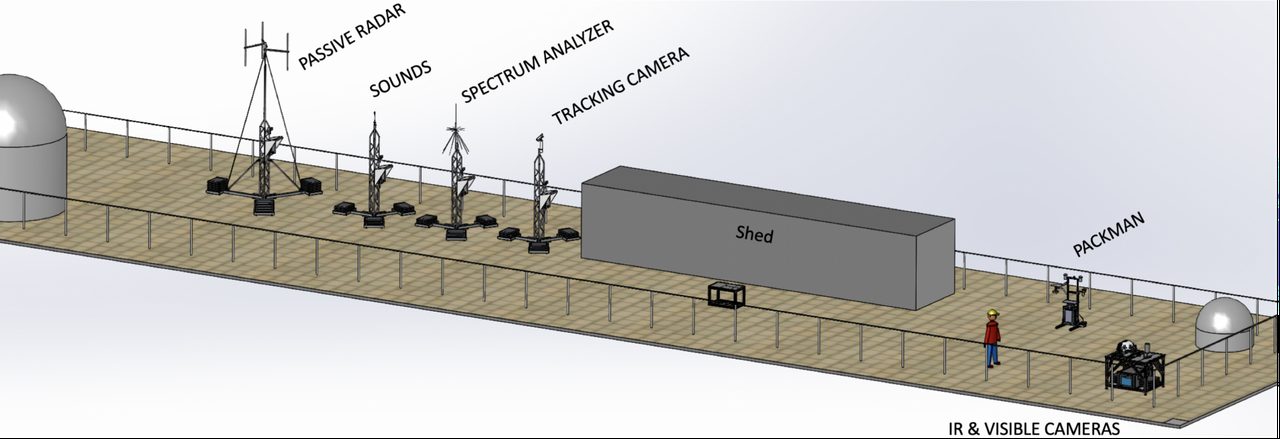
The plan is a network of observatories that watch the whole sky at once and record everything as calibrated, time-synchronised, multi-wavelength data, so that an event produces physics instead of an anecdote. The project's own design paper, published in the Journal of Astronomical Instrumentation in 2023 with 38 named authors, specifies the suite: wide-field cameras in several bands for targeting and tracking by triangulation, narrow-field instruments for morphology, spectra, polarimetry and photometry, passive multistatic arrays of antennas and receivers for radar-derived range and kinematics, radio spectrum analysers, microphones from the infrasonic through the ultrasonic, and environmental sensors. One precision point our own file gets wrong and this dossier corrects: the radar is passive. The observatories transmit nothing. They read the reflections of other people's transmitters. Loeb's own summary of the same suite adds magnetic-field strength and charged-particle count.
The first observatory went up on the roof of the Harvard College Observatory in Cambridge, Massachusetts, with further deployments planned, and the team behind it is international, spread across institutions and disciplines. Behind the sensors sits software: machine-learning algorithms that discard satellites, aircraft, birds and weather, and push whatever survives to a human analyst. That filter is the real product. Anybody can point a camera at the sky. The hard part is the sorting.
The stated goal, in the project's own peer-reviewed overview, is put like this: 'The Galileo Project is the first systematic scientific research program in search for potential astro-archaeological artifacts or remnants of extraterrestrial technological civilizations (ETCs) or potentially active equipment near Earth.' Hold that word first lightly, and this dossier will hold it lightly throughout: a valley in Norway has been under scientific study since 1983, and our own research file says so on its own page. One more piece of housekeeping, done in public because it should be visible. That same file puts a memorable line in quotation marks and attributes it to Loeb, about bringing the study of UAP from the fringes to the mainstream of science. We could not locate that exact sentence in any source, so it is not carried here as a quotation, and the abstract above stands in its place.
The reaction from named scientists arrived immediately and it was split. Lucianne Walkowicz of the Adler Planetarium said the project 'could serve to legitimize those kinds of investigations.' Jason Wright of Penn State credited the systematic data-collection approach despite the field's reputation. Mick West placed UAP in what he called a 'low-information zone.' Abel Mendez of the University of Puerto Rico argued that actual visitation should have left physical artifacts behind. And the sharpest doubt came from inside Loeb's own institution: Jonathan C. McDowell of the Harvard-Smithsonian Center for Astrophysics said he worried the project could be too ambitious and unfocused, questioned whether more well-motivated projects merited the funding, said the boring explanation is almost always right, and put it to The Harvard Crimson plainly: 'My fear is you spend a lot of money and you see nothing.'
One name usually filed with the critics belongs on the other side of the ledger, and getting it right matters more than the quote does. Mercedes Lopez-Morales, the Harvard astronomer whose line about incomplete data gets quoted against the project, is a member of the Galileo Project's own Scientific Advisory Board. She said the project is likely to offer natural explanations for UAP, and she named a limitation from the inside before naming a strength: the data 'will also be incomplete in a way that is not going to cover all wavelengths. There should be also radar observations and so on,' she said. 'But at least in terms of a time baseline, it will be more complete than anything else that is currently available.' An advisory-board member describing the limits of her own project is a different thing from an outside critic, and this dossier will not blur them.
03The First Real Number Anyone Has Had
On 28 January 2025 the project published the first result from the camera array itself, and it is a commissioning paper rather than a discovery paper. 'Commissioning an All-Sky Infrared Camera Array for Detection of Airborne Objects' appeared in Sensors under sixteen authors led by Laura Domine, with Abraham Loeb and Wesley Andres Watters among them but not in the first five. The instrument is an all-sky array of eight uncooled long-wave-infrared FLIR Boson 640 cameras sited in Massachusetts. Over a five-month operating period it reconstructed approximately 500,000 trajectories. Detection efficiency, meaning the fraction of recorded aircraft the system actually identified, averaged 36 percent per frame and varied with weather, distance and aircraft size; for ADS-B-equipped aircraft passing through the cameras' fields of view the acceptance rate was 41 percent. Roughly 16 percent of trajectories tripped an outlier test based on how much the path wandered. Manual review of those left 144 trajectories ambiguous, and the paper's own characterisation of the 144 is the part that matters: likely mundane objects, lacking sufficient kinematic data for definitive classification. A statistical analysis established an upper bound of 18,271 outliers at 95 percent confidence across the whole five-month interval.
Read that paragraph again, because it is the most honest thing in this dossier and it came from the project itself. An instrument that misses most of what it looks at is not a triumph, and the team published the figure anyway. They published a count of the objects they could not resolve, then immediately told the reader those are likely mundane. They even published a ceiling on how wrong the whole exercise might be. Set that against the alternative on offer, which is a library of anecdotes carrying no error bars at all.
Whether this approach ever works is still open, and our research file grades it that way. Several groups, the Galileo Project among them, are developing machine-learning classifiers to distinguish UAP from known objects in sensor data. Whether such systems will achieve sufficient discrimination to identify a genuinely anomalous object amid the vast background of conventional phenomena remains to be demonstrated. The 36 percent figure is the first hard measurement anybody has put against that question, and it came from the people with the most to lose from it.
04Where Loeb Came From, And Why It Matters
None of this starts with UAP. It starts with a rock. On 19 October 2017 the Pan-STARRS 1 telescope in Hawaii detected 1I/2017 U1, named 'Oumuamua, the first interstellar object ever detected passing through our solar system. It behaved strangely. Its light curve implied either extreme elongation or a flat disc, it was highly reflective, and it accelerated on the way out with no visible outgassing to push it. That acceleration is not a rumour: it was measured and published in Nature in 2018 by Marco Micheli, Davide Farnocchia, Karen J. Meech, Marc W. Buie and co-authors. One thing to be clear about, because almost every picture you have seen of this object gets it wrong: no telescope ever resolved 'Oumuamua as anything but a point of light. The shape is inferred from the light curve. Nobody has an image of it.
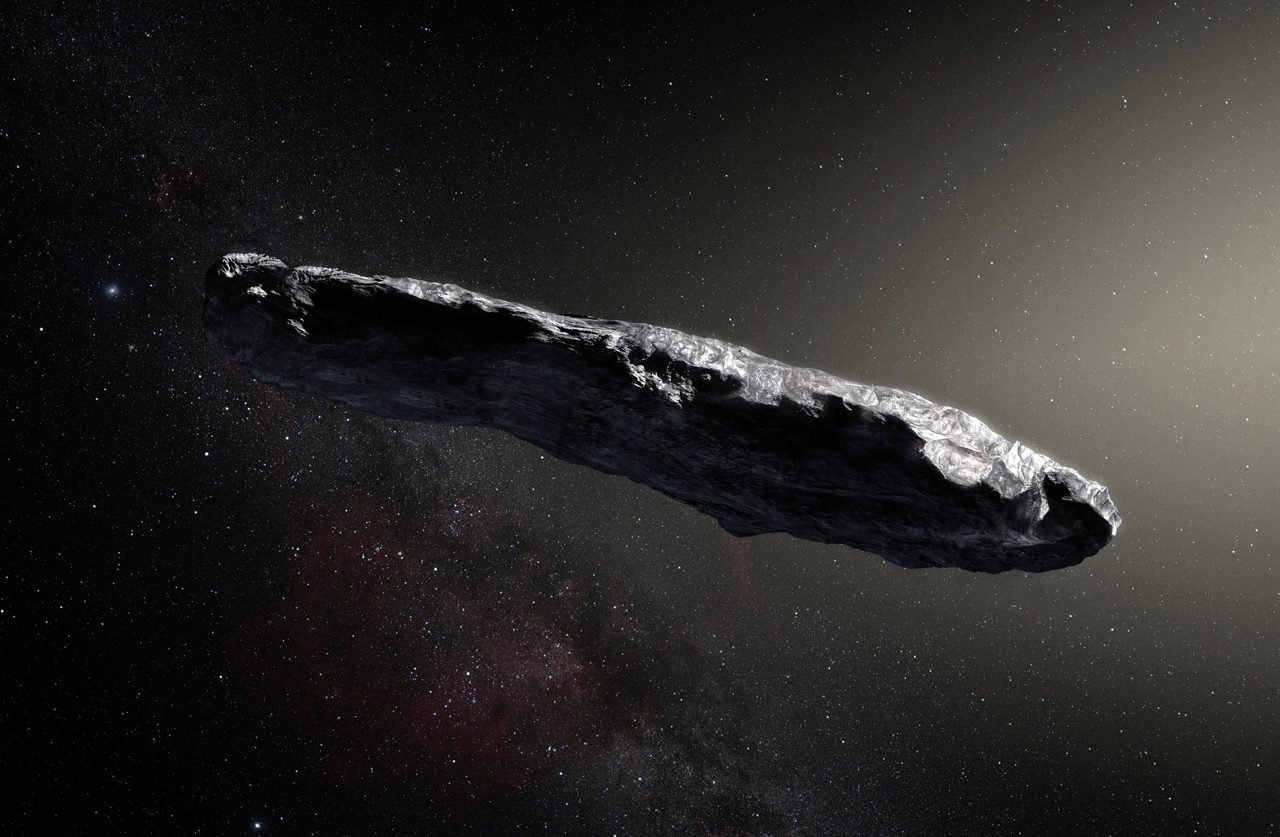
In 2018 Shmuel Bialy and Abraham Loeb published 'Could Solar Radiation Pressure Explain 'Oumuamua's Peculiar Acceleration?' in The Astrophysical Journal Letters. The argument in the paper is narrower than its reputation: a thin, low-density sheet driven by solar radiation pressure would fit the observed acceleration. The paper's discussion raises an artificial origin as one possibility. It is not framed as a demonstration. The wide version of the claim, the one people remember, arrived with his 2021 popular book Extraterrestrial.
Most astronomers did not agree then either, and this is where the fairness has to be spent, because our own file states the disagreement and names nobody in it. In 2019 the 'Oumuamua ISSI Team, fourteen researchers including Michele T. Bannister, Alan Fitzsimmons, Karen J. Meech and Colin Snodgrass, published 'The natural history of 'Oumuamua' in Nature Astronomy and concluded that in all cases the observations are consistent with a purely natural origin. In 2023 Jennifer B. Bergner and Darryl Z. Seligman supplied a specific mechanism in Nature: molecular hydrogen produced radiolytically inside water ice during the interstellar crossing, outgassing later and accelerating the object without a visible cometary coma. What the episode did establish is that Loeb will take an artificial hypothesis seriously in print, which is the disposition that produced the Galileo Project and the disposition his critics object to.
Which brings us to a patch of seafloor north of Papua New Guinea, and to the part of this story where the separation this dossier is built on stops being a nicety.
05The Pacific Spherules: What The Papers Actually Say
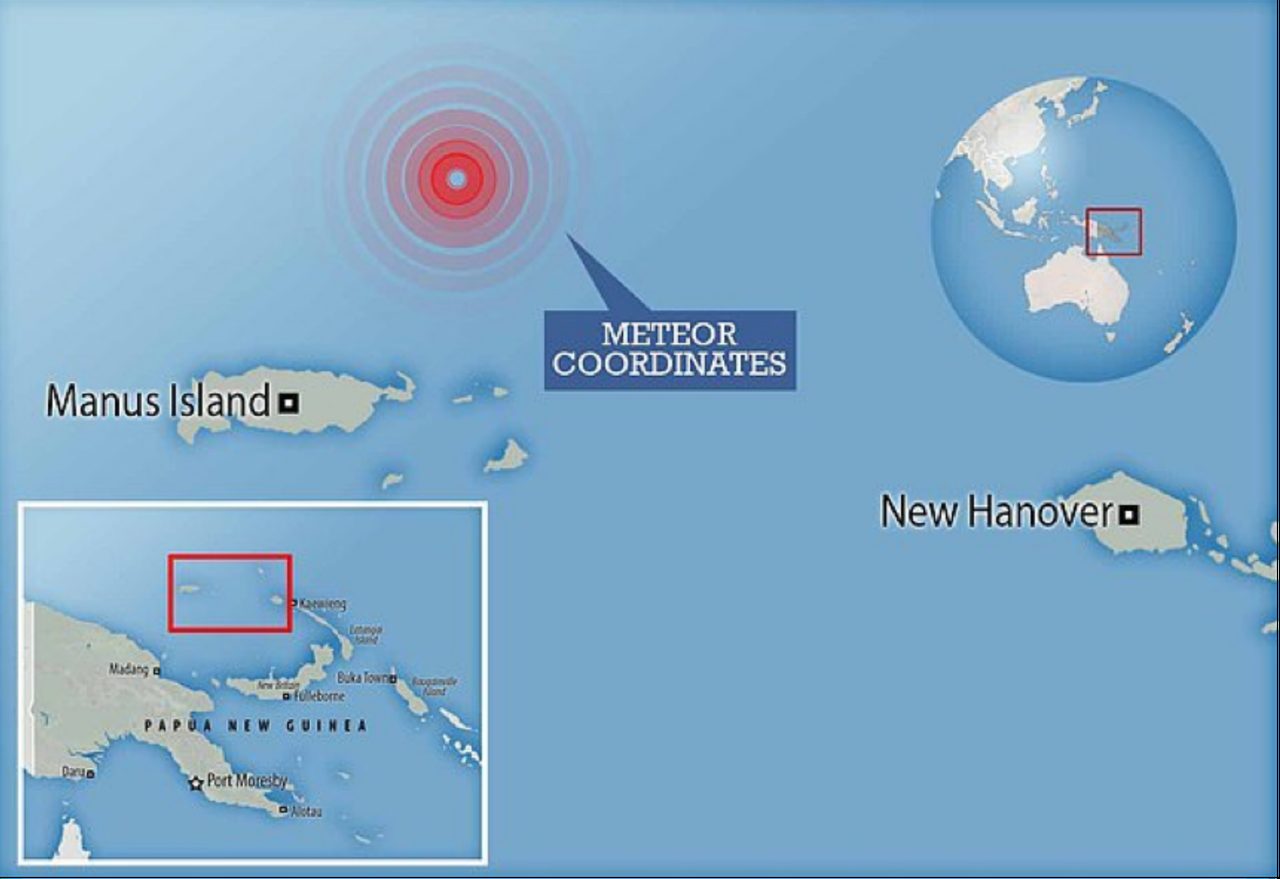
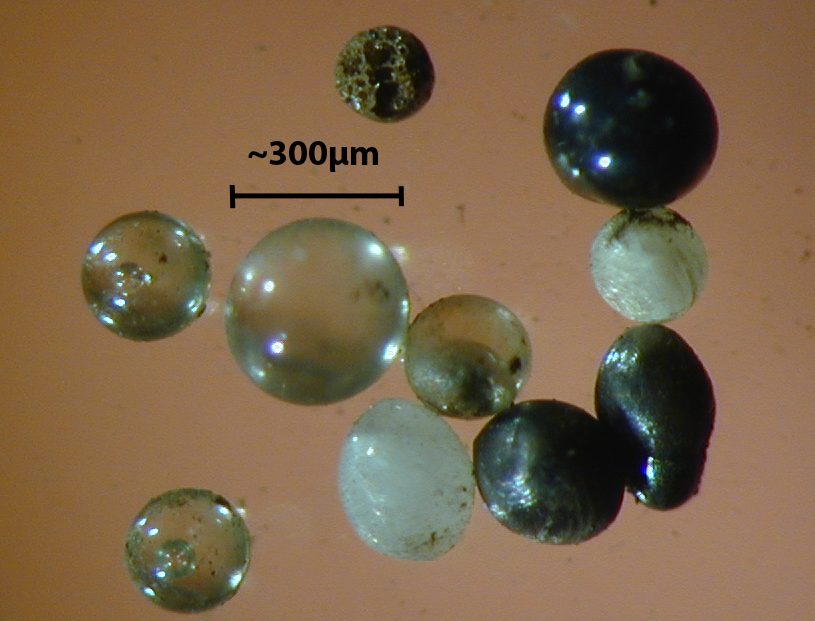
From 14 to 28 June 2023 the project ran a towed magnetic sled over the seafloor about 85 km north of Manus Island, Papua New Guinea, along the calculated path of a bolide catalogued as CNEOS 2014-01-08, or IM1. About 850 spherules of 0.1 to 1.3 mm diameter were recovered. The recovery was written up in Research Notes of the AAS in 2024. The chemistry followed the same year in Chemical Geology, in a paper with 31 authors led by Loeb with Stein B. Jacobsen and R. Tagle, using micro-XRF, an electron probe microanalyser and ICP mass spectrometry. Spherules comprising 22 percent of the collection appear to reflect planetary igneous differentiation. A subset shows an excess of beryllium, lanthanum and uranium by up to three orders of magnitude relative to the CI chondrite solar-system standard. Detailed mass spectrometry of 12 of these 'BeLaU' spherules, possibly up to about 10 percent of the whole sample, suggests derivation from material formed by planetary igneous fractionation.
Now the part the coverage skipped. The strongest wording in that peer-reviewed abstract is that the composition 'is unlike any known solar system material' and reflects 'a highly differentiated, extremely evolved composition of an unknown source.' That is the entire claim. The abstract makes no technological claim at all, and no explicit claim that the material came from outside the solar system. Two peer-reviewed papers, one genuinely unusual chemistry, and one honest phrase: unknown source.
The alien-technology reading did not come from those papers. It lives in the project's press material and in Loeb's own blog posts, and it travelled far enough that the rebuttal paper names what it is answering: 'Previous work had suggested that this meteor may have been caused by an alien spacecraft burning up in the atmosphere.' That gap between the journal record and the press record is not a technicality. It is the difference between an unusual chemistry result and a claim about visitors, and this dossier holds them apart because the evidence holds them apart.
06The Rebuttals, And Which Of Them Are Peer-Reviewed
The strongest published attack arrived in 2024, in Geophysical Journal International, from Benjamin Fernando, Pierrick Mialle, Goran Ekstrom, Constantinos Charalambous, Steven Desch, Alan Jackson and Eleanor K. Sansom, under a title whose scare quotes are the journal's own: Seismic and acoustic signals from the 2014 'interstellar meteor'. It makes four moves and they get worse as they go. First, 'both previously reported seismic signals are spurious.' Second, 'one has characteristics suggesting a local vehicular-traffic-based origin; whilst the other is statistically indistinguishable from the background noise.' Third, 'previously reported localizations based on this data are unreliable,' and the acoustic analysis 'provides a best-fitting location estimate which is very far (~170 km) from the reported fireball location.' Fourth, and this is the move that reaches past the map to the material itself: 'we conclude that material recovered from the seafloor and purported to be from this event is almost certainly unrelated to it, and is likely of more mundane (non-interstellar) origin.' The same work was first presented at the 2024 Lunar and Planetary Science Conference under a title with no diplomacy in it whatsoever: 'Probably Not Aliens: Seismic Data Analysis From the 2014 Interstellar Meteor'.
Two more peer-reviewed challenges sit alongside it, aimed at different joints. In 2023 Peter G. Brown and Jiri Borovicka argued in The Astrophysical Journal that the US government sensor velocity data for this fireball carry uncertainties large enough that an interstellar origin is not established, which pulls the ground out from under the premise rather than the search area. Also in 2023, Patricio A. Gallardo argued in Research Notes of the AAS that the nickel, beryllium, lanthanum and uranium contents of the recovered spherules are consistent with anthropogenic coal ash, drawing on the COALQUAL coal-composition database, and therefore disfavour a meteoritic origin. Loeb's group disputes the coal-ash match.
Two further challenges are preprints, and this dossier labels them every single time they appear, because the difference is the entire point of the section. In November 2023 Steve Desch and Alan Jackson posted a critique to arXiv arguing that the iron isotopic ratios 'decisively indicate an origin in our Solar System, with greater than 99.995 percent probability,' that the unusual enrichments attributed to an extrasolar origin have been observed before and linked to terrestrial contamination, and that the recovered spherules 'appear to be just like those found around the world, with a Solar System origin.' In March 2024 Desch posted a second preprint, listed on arXiv as submitted to Meteoritics and Planetary Science, proposing that the BeLaU spherules are microtektites of terrestrial lateritic sandstone from the Australasian tektite strewn field, generated about 788,000 years ago by an impactor that melted and ejected material from Indochina. Note the symmetry, because it is fairer to both sides than the usual telling: at that stage of the argument the Loeb work being attacked was itself a preprint. Everybody went public before peer review.
| The Challenge | Where It Stands | What It Argues |
|---|---|---|
| Fernando And Six Co-Authors, 2024 | Peer-reviewed, Geophysical Journal International | Both reported seismic signals are spurious, the localisations based on them are unreliable, the acoustic best fit sits about 170 km from the reported fireball location, and the recovered material is almost certainly unrelated to the event |
| Brown And Borovicka, 2023 | Peer-reviewed, The Astrophysical Journal | The US government sensor velocity data carry uncertainties large enough that an interstellar origin is not established |
| Gallardo, 2023 | Peer-reviewed, Research Notes of the AAS | The spherule chemistry is consistent with anthropogenic coal ash, which disfavours a meteoritic origin |
| Desch And Jackson, 2023 | arXiv preprint, not peer-reviewed | Iron isotopic ratios indicate a solar-system origin, and the unusual enrichments have been linked before to terrestrial contamination |
| Desch, 2024 | arXiv preprint, listed as submitted to Meteoritics and Planetary Science | The spherules are terrestrial microtektites of lateritic sandstone from the Australasian tektite strewn field |
One thing the reader deserves, and it cuts toward Loeb. These are not five independent research groups. Steven Desch is a co-author of the Geophysical Journal International paper, the author or co-author of both preprints, and the scientist quoted criticising Loeb by name in 2026. Alan Jackson appears on two of them. Saying so is more honest than letting a count of five do rhetorical work the authorship lists do not support.
07And Then Loeb's Group Answered, In Print
On 20 October 2025 the answer arrived in a peer-reviewed venue. Eugenia Hyung, Emma Levy, Loralei Cook, Stein B. Jacobsen, Abraham Loeb, Jayden Squire and Juraj Farkas published a direct comparison in Research Notes of the AAS: 'Our findings corroborate previous studies that Australasian tektites and microtektites closely resemble the elemental abundance patterns of the UCC. Meanwhile, the elemental patterns of the BeLaU-spherules are distinct from the Australasian tektite/microtektite compositions.' In the paper's Results and Discussion the differences are named specifically: beryllium and uranium enriched relative to upper continental crust, and, set against the tektites, enrichment in the heavy rare earth elements. Whatever else is true, the tektite hypothesis was answered on its own ground.
So nobody should tell you this was settled in either direction. The localisation that chose the search area is under serious peer-reviewed attack; the strongest of those papers says the recovered material is almost certainly unrelated to the event; the alternative origins on offer are coal ash and Australasian microtektites; and the group that recovered the spherules has answered the tektite version in print and says the chemistry does not match. That is what a live scientific dispute looks like from the inside. It is not a verdict, and anybody handing you one is selling something.
08The Others Building The Same Thing
The Galileo Project is not alone, and our research file grades this next tier of the story as credible rather than verified. UAPx is a nonprofit scientific organisation that puts calibrated instrumentation in the field: scientists, engineers and military veterans, deploying equipment at locations with a history of recurring reported activity. Its first major expedition went to Catalina Island off the southern California coast in 2021, water with a long record of reported UAP and USO activity that overlaps Navy training ranges. Our own file lists radar among their instruments. The published paper does not describe radar on that expedition, and gives observable-light and infrared cameras plus non-electromagnetic sensors including background radiation instrumentation.
The file also says UAPx is preparing results for peer-reviewed publication. That is out of date, and the correction is more interesting than the original. Matthew Szydagis, Kevin H. Knuth, Benjamin W. Kugielsky and Cecilia Levy published in Progress in Aerospace Sciences in June 2025. The expedition ran for a week in July 2021 in and near Avalon, California, on Catalina Island, with faculty from the University at Albany Department of Physics. It gathered about one hour of triggered visible and night-vision-mode video, more than 600 hours of untriggered far-infrared video, and 55 hours of background radiation measurement. After several initially ambiguous cases were resolved one by one, exactly one remained: a dark spot in the visible and near-infrared camera at approximately 4am Pacific on Friday 16 July, possibly coincident with ionising radiation, which the authors say 'has so far resisted prosaic explanation.' The paper's own abstract promises 'a frank discussion of the successes and failures.' That is what an honest field report reads like, and it is nothing like the version our file carries.
The Scientific Coalition for UAP Studies works the other end of the problem, applying standard scientific and engineering analysis to data that already exists: systematic review, physical analysis and evaluation of sensor data. Its 2015 technical report is on 2013 infrared footage from US Customs and Border Protection over Aguadilla, Puerto Rico, by Robert M. Powell, Morgan Beall, Larry Cates, Carl Paulson, Richard Hoffman and Daina Chaviano. The record states that 'a three-minute video was taken by a Wescam MX-15D IR camera that operates in the 3-5 micron region of the infrared,' obtained from a Department of Homeland Security thermal video captured from an aircraft tracking an unidentified object. The report describes an object crossing an urban area at night without lights, at times below tree-top altitude, at speeds approaching 100 mph, entering the water with minimal splash, emerging, and dividing into two. Two things to hold steady: this is an organisational technical report with a persistent archival identifier, not a journal paper, and the coalition's analysis of the Nimitz encounter data is a separate matter we keep in its own case file.
The Sol Foundation, established in 2023, exists to give UAP research an academic forum, to support academic careers in the subject and to move work toward peer-reviewed venues. Its inaugural conference ran on 17 and 18 November 2023 at Stanford University, presented by the Nolan Laboratory in Stanford's Department of Pathology and the Stanford School of Medicine, organised by Dr Garry Nolan as chairman and Dr Peter Skafish as director. Read that sentence carefully, because the distinction is exactly the one we drew about Harvard: a Stanford laboratory hosting an event is not a Stanford University institutional programme. The foundation's own confirmed speakers list runs to seventeen names, among them Jacques Vallee, Kevin Knuth of the University at Albany, Christopher Mellon, Hal Puthoff, Diana Walsh Pasulka, Beatriz Villarroel, Timothy Gallaudet and Karl Nell, whom the foundation lists as US Army, retired, and former Deputy Chief of Staff of US Africa Command. Our own file gives Nell the rank of colonel; the foundation's own page does not, so it is not printed here.
And NASA. In 2022 the agency commissioned an independent study team on UAP, chaired by the astrophysicist David Spergel, president of the Simons Foundation, and made up of 16 community experts. The final report was released on 14 September 2023. It recommended that NASA use open-source resources and its own technological expertise for data collection, establish systematic data calibration with multiple measurements and sensor metadata, engage citizens and commercial pilots to build reliable datasets, and apply artificial intelligence and machine learning to the search for anomalies. Its own limiting sentence is the one worth carrying: there are 'currently a limited number of high-quality observations of UAP, which currently make it impossible to draw firm scientific conclusions about their nature.' On the same day NASA named Mark McInerney its Director of UAP Research; he had held roles at NASA, NOAA and the National Hurricane Center since 1996 and had been the agency's liaison to the Department of Defense on UAP.
Two small corrections to our own file while we are here. It says the report recommended establishing a dedicated UAP research directorate. What NASA created was a post, a Director of UAP Research, which is a job rather than an organisational unit, and the file's own next sentence gets it right. The file also calls that post the first such position at the agency, which we carry as its claim rather than as something we checked. The observational vocabulary the study team works in is in The Five Observables.
09The Valley That Has Been Doing This Since 1983
There is a precedent, and our research file calls it the longest-running continuously instrumented programme of this kind. In the Hessdalen valley in central Norway residents reported strange lights repeatedly from the end of 1981 through 1984, and the project's own record says it was established in the summer of 1983, with a field investigation running from 21 January to 26 February 1984 during which fifty-three light observations were made. An automatic measurement station followed. The project's own page dates system 1 to 7 August 1998 at 10 o'clock at night, and gives its equipment as one black-and-white CCD camera connected to a computer and a video recorder, plus a magnetometer connected to another computer. Our file lists radar and spectrometers in that 1998 configuration and the project's own page does not; the station was expanded later, with a second system from the end of July 2001, a weather station in 2002 and a high-sensitivity black-and-white camera in 2003. One connection worth naming: Massimo Teodorani, the Italian physicist who ran the long Hessdalen surveys, is one of the 38 authors on the Galileo Project's design paper. The two lines are joined by a co-author.
The serious current science on Hessdalen is geological, and the programme's own people are on it. In 2024 G.N. Vargemezis, J. Zlotnicki, B.G. Hauge, A.L. Kjoniksen and E.P. Strand published a very-low-frequency electromagnetic survey in the Journal of Applied Geophysics, reporting several conductive zones related mainly to mineral deposits, primarily sulphides, whose surface trace follows a gabbro intrusion oriented southwest to northeast. Their argument is that these near-surface structures could contribute to generating the lights and could help explain why they appear in that particular valley.
A word about the phrase peer-reviewed publications, which our research file uses without differentiating, because the difference is the same discipline this whole dossier is about. The long-cited Hessdalen survey, Massimo Teodorani's 2004 paper, appeared in the Journal of Scientific Exploration, which peer-reviews by its own account but is not a mainstream astronomy or geophysics journal. The 2024 electromagnetic survey above is in a mainstream applied geophysics journal. Both are on the record, and telling them apart is not pedantry. The valley itself, and what has been seen there, belongs to Window Areas.
10June 2026: The Government Puts Loeb In The Chair
In June 2026 the Office of the Director of National Intelligence, together with the White House, the Department of Defense and the FBI, established a UAP Science Advisory Council and tasked Avi Loeb with establishing and chairing it. The council reports to a newly established UAP Governance Board overseen by ODNI, which met for the first time that month. An ODNI official described the board's purpose as being 'to provide guidance, recommendations and coordination at the interagency level, bringing together military, law enforcement, the intelligence community, and other civilian agencies.' Loeb's own statement of the mission is one sentence: 'The goal of the council is to advise the U.S. government on how to resolve the nature of [UAP].' Then look at the reported membership, because it reads as this dossier's cast list: Carol Cleland, Richard Cloete, Omer Eldadi, Tim Gallaudet, Ross Howard, Ben Lamm, Devesh Nandal, Garry Nolan, Michael Shermer, Peter Skafish, Matthew Szydagis and Jennice Vilhauer. Szydagis led the UAPx paper. Nolan and Skafish run the Sol Foundation. Cloete and Cleland are Galileo Project co-authors. Shermer is a well known professional sceptic.
The criticism was immediate, and named. Steve Desch of Arizona State University, the same astrophysicist behind three of the five challenges above, told the Associated Press: 'I don't know what's going to come of this, but we're not going to get any closer to answering these questions with him in charge.' Sean Kirkpatrick, a physicist and the former head of the Pentagon's All-domain Anomaly Resolution Office, said Loeb is 'not viewed favorably' in the scientific community, said he lacks national security experience, and suggested the White House was prioritising fringe theories over rigorous science. Loeb's reply, in the same coverage: 'It's like a detective story. It's a lot of fun, as long as you don't pay too much attention to the critics,' and 'Let's keep our eyes on the orbs, not the social media.'
Which retires a claim our research file had already tagged [OUTDATED]: that academic UAP research will be blocked. Institutional stigma against the subject has historically been severe, and the file says so. But programmes now exist at Harvard, at Stanford and at NASA, and in June 2026 the US government handed the chair of a science advisory council to the most conspicuous UAP scientist in the country. The barrier is weakening. What has not gone away is career risk for junior researchers, and what the same week demonstrated is that the argument moved with the barrier instead of ending: the appointment itself is now what two named scientists are objecting to in public.
One last structural fact, and it is the quietest interesting thing here. Kevin Knuth is a co-author of the UAPx paper, an author on the Galileo Project's design paper, a speaker at the Sol Foundation's inaugural conference and the lead author of the Entropy paper this dossier opened with. Massimo Teodorani links Hessdalen to Galileo. Richard Cloete links Galileo to the federal council. This is not a movement with a thousand independent laboratories. It is a small number of people who keep appearing in each other's author lists, which is worth knowing when you read a paper and a rebuttal and wonder how independent they really are.
Fast Facts
- Founded
- Announced 26 July 2021 by Avi Loeb with 1.755 million US dollars in private donations, subsequently expanded. Co-founder and donor: Frank H. Laukien.
- Based At
- Harvard University, with an international team across institutions. The first observatory was deployed on the roof of the Harvard College Observatory in Cambridge, Massachusetts.
- The Instrument
- Wide-field and narrow-field cameras, passive multistatic radar receivers that read other transmitters' reflections rather than transmitting, radio spectrum analysers, infrasonic to ultrasonic microphones and environmental sensors, time-synchronised and feeding a machine-learning filter.
- The Array's First Result
- Sensors, 28 January 2025: an all-sky array of eight infrared cameras, five months of operation, approximately 500,000 reconstructed trajectories, a 36 percent average per-frame detection efficiency, and 144 trajectories left ambiguous which the paper itself characterises as likely mundane objects lacking sufficient kinematic data for definitive classification.
- The Famous Claim
- About 850 spherules recovered from the seafloor about 85 km north of Manus Island in June 2023. The peer-reviewed chemistry says the composition is unlike any known solar system material and reflects an unknown source. It makes no technological claim.
- The Dispute
- Five challenges on the record: three peer-reviewed (Fernando et al. 2024, Brown and Borovicka 2023, Gallardo 2023) and two arXiv preprints (Desch and Jackson 2023, Desch 2024). Loeb's group answered the tektite version in a peer-reviewed research note in October 2025. Nothing is settled.
- The Precedent
- Project Hessdalen in central Norway, established in the summer of 1983, with an automatic measurement station in operation since 7 August 1998.
- The Others
- UAPx (published in Progress in Aerospace Sciences, June 2025), the Scientific Coalition for UAP Studies, the Sol Foundation (inaugural conference at Stanford, November 2023) and NASA's independent study team (report released 14 September 2023).
- The 2026 Turn
- In June 2026 ODNI, the White House, the Department of Defense and the FBI established a UAP Science Advisory Council and tasked Loeb with chairing it. Two named scientists objected publicly.
- What Is Still Missing
- A calibrated multi-sensor detection that survives review and settles anything. What the published record actually holds is 144 Galileo Project trajectories its own authors call likely mundane, and one dark spot from the UAPx expedition that its authors say has so far resisted prosaic explanation.
What The Galileo Project Has Actually Established
The programme is real, documented and publishing. The Galileo Project was announced on 26 July 2021 with 1.755 million US dollars in private funding, is based at Harvard, and has put its overview, its observatory design, its computing platform and its first commissioning result through peer review. That first result, in Sensors on 28 January 2025, reports eight infrared cameras, five months, approximately 500,000 reconstructed trajectories, a 36 percent average per-frame detection efficiency and 144 trajectories its own authors characterise as likely mundane. Avi Loeb's institutional standing is exactly what Harvard's own pages say it is. About 850 spherules were recovered from the seafloor about 85 km north of Manus Island in June 2023 and their chemistry was published in Chemical Geology. Every one of those is checkable. What is contested is not that the expedition sailed or that the chemistry was measured, but what the material is and whether it has anything to do with the 2014 event, and that argument sits two tiers down.
One step down sit the parallel programmes as organisations, which our research file grades credible and this dossier does not upgrade. UAPx, the Scientific Coalition for UAP Studies and the Sol Foundation are all real and all doing work with names attached, and what they are rests largely on their own accounts of themselves. Their individual outputs are graded separately above on their own merits, which is why the UAPx expedition paper stands at Tier 1 in Progress in Aerospace Sciences while the Aguadilla analysis does not: the second is an organisational technical report with an archival identifier, not a journal paper. The two preprint challenges to the spherule interpretation belong at this tier too, credible and no higher, because a preprint is not a peer-reviewed paper however strong its argument reads.
Genuinely open, and likely to stay open a while. Whether machine-learning classifiers will ever discriminate well enough to pull a genuinely anomalous object out of the ordinary background is undemonstrated, and the project's own commissioning numbers are the first real measurement of how far there is to go. What the BeLaU spherules are is unresolved: the strongest peer-reviewed attack concludes the recovered material is almost certainly unrelated to the 2014 event and likely of mundane origin, one peer-reviewed alternative proposes coal ash, a preprint proposes Australasian microtektites, and Loeb's group answered the tektite version in a peer-reviewed note in October 2025 and says the chemistry does not match. A live dispute, no winner, and anybody offering you one has picked a side rather than read the papers.
Two things this dossier refuses outright. No, citizen video is not sufficient evidence, and our file's own [CONTRADICTED BY METHODOLOGY] tag on that claim is correct: uncalibrated footage cannot deliver range, speed, size or spectral characteristics, which is precisely why purpose-built instruments exist. And no, the peer-reviewed record contains no claim that the Pacific spherules are alien technology; the strongest published wording is unlike any known solar system material, from an unknown source, and the technological reading lives in press material and blog posts instead. One refusal is aimed at our own library: the research file's Counter-Arguments section asserts that no significant counter-arguments exist in the scholarly literature for its core claims and that there is no active scholarly dispute. On this subject that is simply false, five challenges on the record say so, and it is not reproduced anywhere above.
Strip the story back and the shape is simple. Somebody finally built the instrument, published its unflattering first numbers, went looking for a fragment of an interstellar object on the seafloor, got specifically and publicly challenged by other scientists, and answered them in the same journals. That is neither a scandal nor a triumph. It is what the process looks like when it is actually running, on a subject that has never had it. Five months of watching the sky bought one honest measurement and 144 trajectories its own authors call likely mundane. So the question this dossier leaves you with is not what the Galileo Project found. It is the harder one: if an array of infrared cameras can see only a fraction of what crosses its own sky, what would an instrument have to be to settle this, who is going to build it, and how much should it worry us that the people who would build it are the same small circle who keep turning up in each other's papers?
Sources & further reading
One research file in our own library stands behind this dossier, I_4_12, and that file is where we worked from, not where we can be checked. It also stops dead in late 2023, and four of the five DOIs in its bibliography resolve to a different work than the one they name, which is why every claim above was rebuilt against the record listed here. The external entries are tied to the sections that use them: the Galileo Project's own peer-reviewed papers, the five challenges to its spherule interpretation with the publication status of each stated, the peer-reviewed reply, and the primary institutional pages behind every date, title and roster. Two of those five challenges are arXiv preprints and are labelled as such wherever they appear. Where our own file and a primary source disagree, this dossier follows the primary source and says so in the text.
Image credits
- The Galileo Project's layout drawing for its first observatory, on the Harvard College Observatory roof drawing by Abraham (Avi) Loeb and Frank H. Laukien of the Galileo Project, via Wikimedia Commons. CC BY 4.0 Source.
- Artist's impression of the interstellar object 1I/'Oumuamua ESO/M. Kornmesser, background position modified by Nagualdesign, via Wikimedia Commons. CC BY 4.0 Source.
- Location of CNEOS 2014-01-08, the first Galileo Project deep-water expedition map by Abraham (Avi) Loeb and Frank H. Laukien of the Galileo Project, via Wikimedia Commons. CC BY 4.0 Source.
- Stony cosmic spherules under a light microscope photograph by Shaw Street, via Wikimedia Commons. CC BY-SA 3.0 Source.
- Avi Loeb, 2023 photograph by Christopher Michel, via Wikimedia Commons. CC BY-SA 4.0 Source.
- Card crop of The Galileo Project's layout drawing for its first observatory, on the Harvard College Observatory roof drawing by Abraham (Avi) Loeb and Frank H. Laukien of the Galileo Project, via Wikimedia Commons. CC BY 4.0 Source.
.png)


