Shapeshifters: The Body That Refuses To Stay One Thing
Name a culture with enough surviving mythology and you will find someone in it who changes shape. Ovid alone set down more than two hundred and fifty transformations. A Norse god became a mare and gave birth to a horse. A Japanese fox that lives a hundred years learns to walk as a beautiful woman. A Scottish seal slips off its skin on the beach and marries the man who hides it. The forms differ, and the meanings differ even more, and that difference turns out to be the whole point. But one idea runs under all of them, an idea some archaeologists trace all the way back to ice-age ivory: that identity is not fixed, that the line between human and animal is thin enough to cross, and that the crossing itself is a kind of power. This is the file on the shapeshifter, opened tradition by tradition, every claim wearing its evidence.
Most mythological creatures are things. A dragon is a dragon; a phoenix is a phoenix. The shapeshifter is the exception, and that exception may be the most widespread idea in all of mythology: not a creature at all, but an event, the moment a body stops being one thing and becomes another. It turns up in every culture that left enough mythology to check. A god does it for pleasure, a trickster does it to escape, a fox does it out of long patience, a witch does it to do harm, a seal does it and cannot go home. The change means something different every time. But the ability to change, and what that ability says about the line between human and animal, stays strangely constant. This is the file on the shapeshifter, opened tradition by tradition, every claim wearing its evidence.
01The Great Catalogue
Start where the West's own catalogue of shape-change begins. Ovid, the Roman poet Publius Ovidius Naso, who lived from 43 BCE to 17 or 18 CE, wrote the Metamorphoses, a single poem in fifteen books that gathers more than two hundred and fifty transformation myths into one running epic of bodies in flux. It is the largest compendium of shapeshifting in all of world literature, and it makes a claim about the gods without ever stating it outright: in Ovid, divine power is exactly the power to become anything. Zeus proves it over and over, and always for seduction. He comes to Leda as a swan, to Europa as a bull, to Danae as a shower of gold, to Ganymede as an eagle. The god does not disguise himself so much as demonstrate that, for him, no form is fixed.
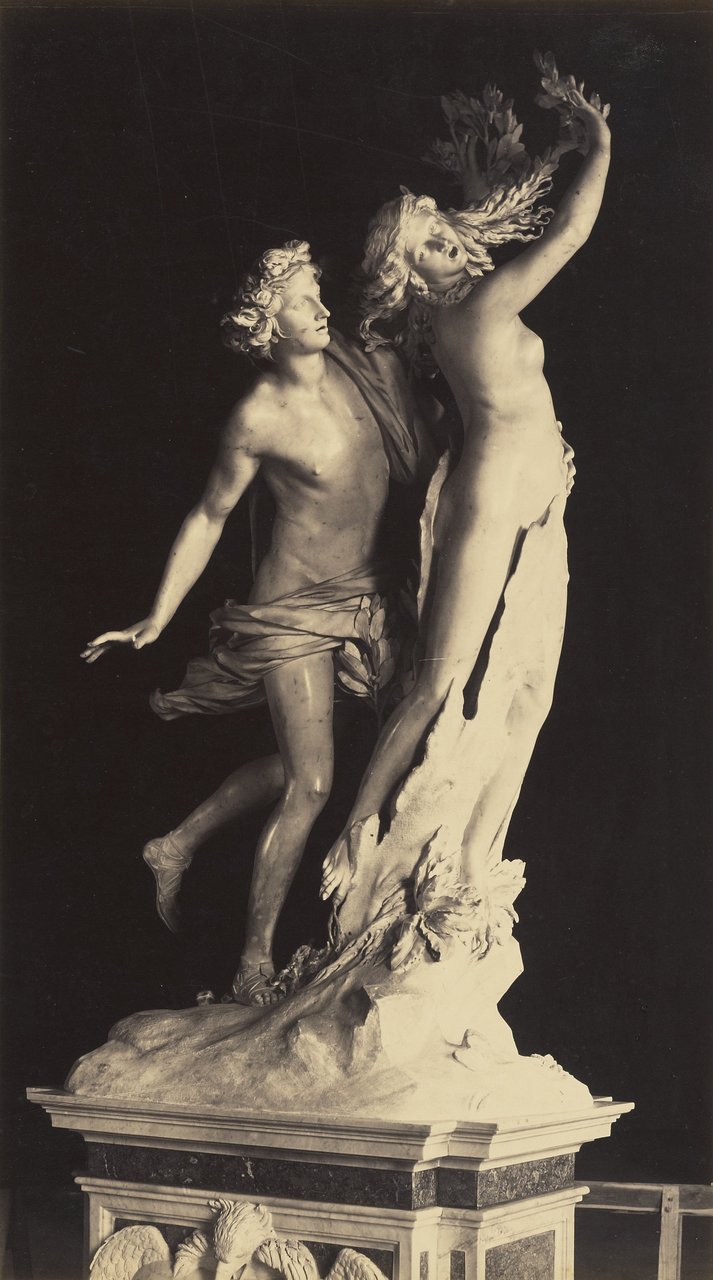
The mortals in the poem change too, but for them the change is a fate rather than a choice, and Ovid uses it in three distinct ways. It can consecrate: Daphne, fleeing the god Apollo, becomes a laurel tree, and her transformed body turns into a sacred object, the laurel wreath itself. It can punish: Arachne, having beaten the goddess Athena in a weaving contest, is turned into a spider, the crime answered by the loss of her human form. And it can reveal: Tiresias, who struck a pair of mating serpents and then spent seven years living as a woman before changing back into a man, draws his famous prophetic knowledge from exactly that crossing, having seen the world as both. Consecration, punishment, revelation. Three different meanings, one mechanism.
02Proteus, And The Word We Kept
One figure in the classical world gave his name to the whole idea. Proteus, the Old Man of the Sea, appears in Book Four of the Odyssey, and to get a straight answer out of him you first have to catch him and hold on, because the instant he is seized he begins to change: into a lion, a serpent, a panther, a boar, then into running water, then into a tree. Only when you keep your grip through every form does he give up and tell the truth. From him English took the word protean, meaning versatile, endlessly changeable, and it is a fair name for this entire file. The serpent is one of the shapes he runs through, which is worth a note of its own: the serpent is among the most frequent forms a shifting god or hero takes across the world's mythologies, a thread we follow in our companion file on the World Serpent.
03Loki, Who Became A Mare
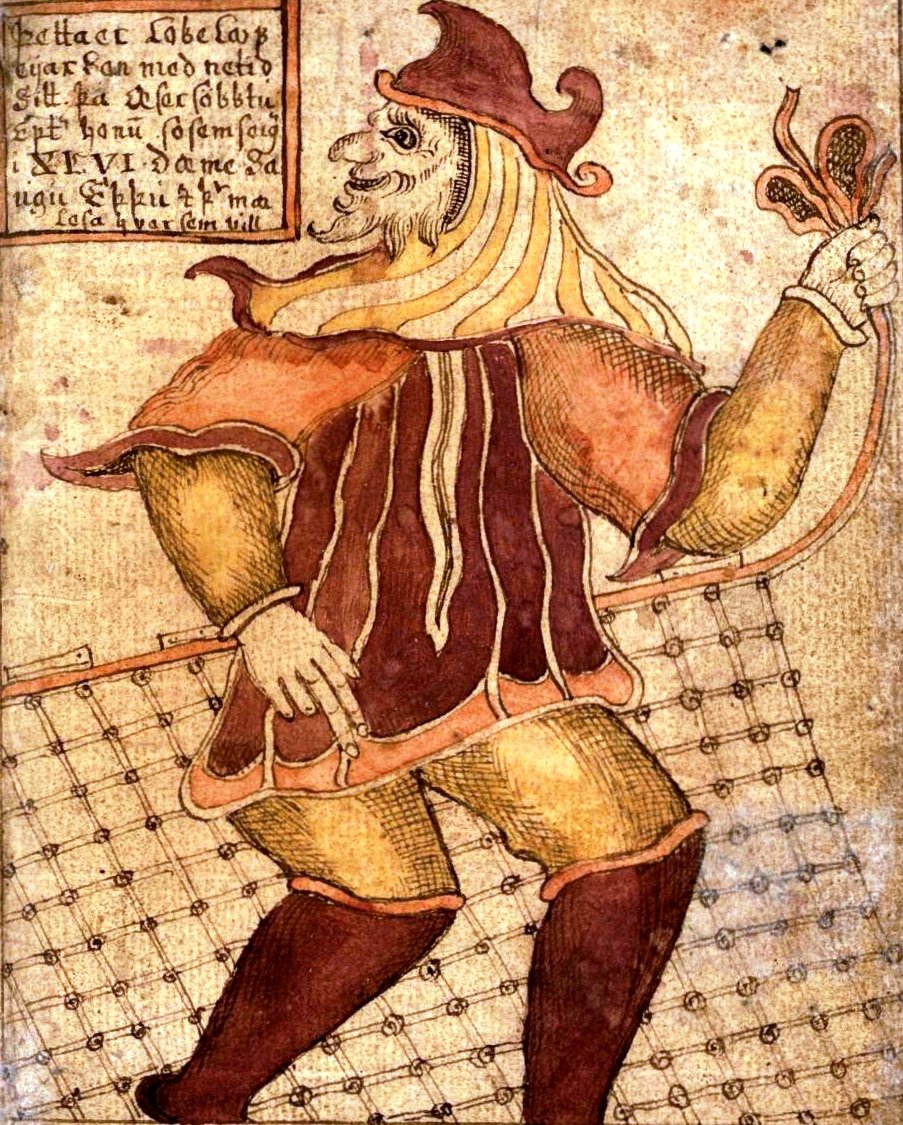
Norse myth has one shapeshifter above all the rest, and he is a god: Loki. His transformations are not incidental color; they are how the stories move. In the Prose Edda he turns himself into a salmon to escape the other gods after one provocation too many, and there is a detail in how they catch him that the tradition clearly savors. They take him in a net, and the net is his own invention. The trickster is undone by the very cunning he is famous for, snared by a thing he thought up himself.
The rest of his shape-changes read like a catalogue of transgressed boundaries. He becomes a fly to slip past the dwarven smiths at their work. He becomes a flea to steal the goddess Freyja's necklace, Brisingamen, in the tale told in the Sorla thattr. He becomes an old woman named Thokk who refuses to weep for the dead god Baldur, and by that single refusal condemns Baldur to stay among the dead in Hel. And, most startling of all, he becomes a mare, mates with the stallion Svadilfari, and gives birth to Sleipnir, the eight-legged horse that Odin himself will ride. That last one crosses two lines at once, species and sex, and leaves Loki the mother of a horse. Nothing in the Norse world is more his than this refusal to hold still inside a single body.
Why does Loki, alone among the great Norse gods, change shape this constantly? The scholar Lewis Hyde, in Trickster Makes This World (1998), reads it as the trickster's whole function: the one who can become Other is the one who can unsettle every fixed category the settled gods depend on. We follow that argument in full in our companion file on the Trickster. Here the point is narrower, and worth keeping in view as the other traditions arrive. For Loki, shapeshifting is not a trick bolted onto his character. It is the character.
04The Fox Who Learned To Be A Woman
Cross to Japan and the most prominent shapeshifter in the folklore is not a god but an animal: the kitsune, the fox spirit. The rule the tradition gives is precise. When a fox reaches fifty years of age, or in some tellings a hundred, it gains the power to take human form, and the form it most often chooses is that of a beautiful woman, a bijin. Foxes are sorted into two kinds. The zenko are good foxes, servants of Inari, the rice deity; the yako are wild foxes and tricksters. A fox's tails count its age and its power, and a nine-tailed fox, the kyubi no kitsune, has reached the ceiling of both and may be something close to divine.
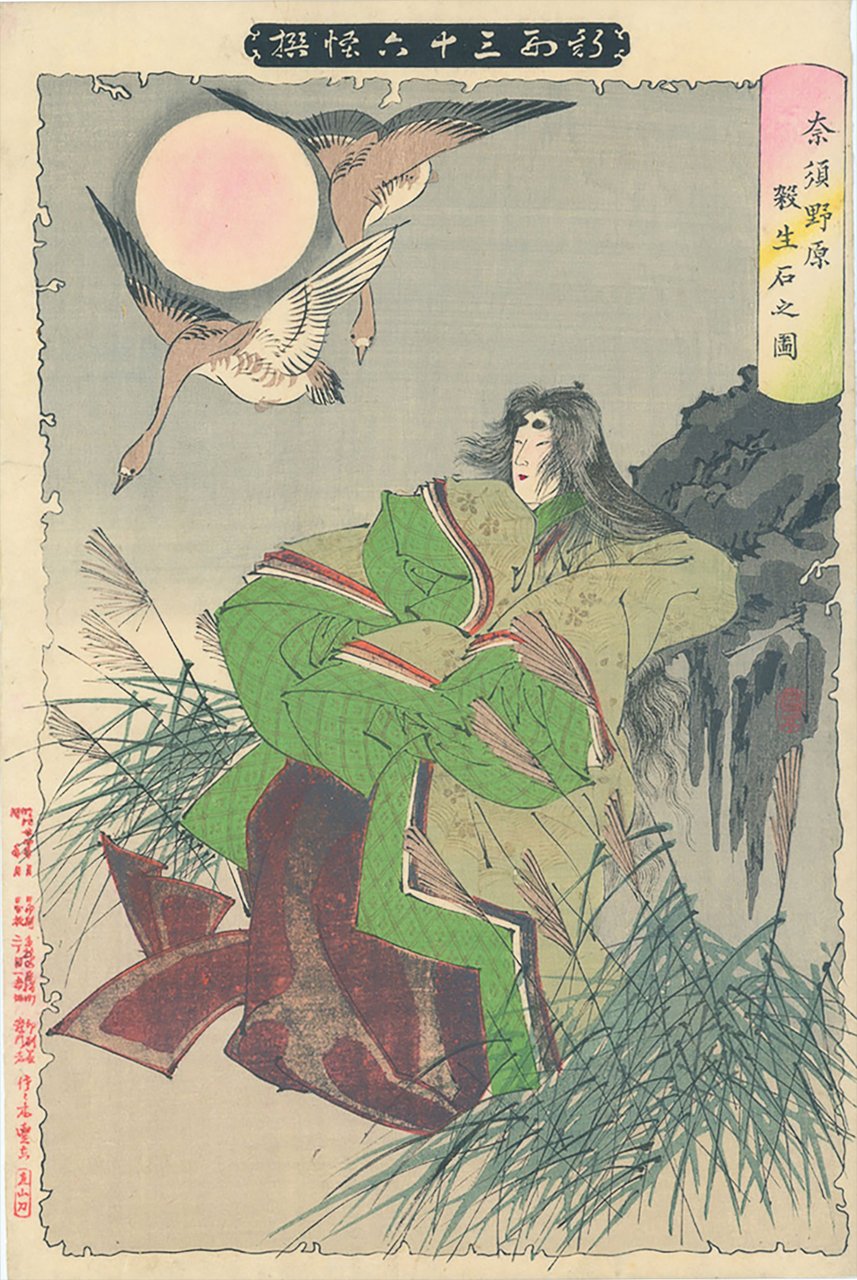
These stories are old and written down. The Konjaku Monogatarishu, a collection from around 1120 CE, already carries several of them. The most famous of all is the legend of Tamamo-no-Mae, from around 1150 CE: a courtesan of extraordinary beauty at the court of Emperor Toba, favored above everyone, who is at last unmasked as a nine-tailed fox that had been scheming all along to kill him. It is the kitsune tale at its most dangerous, beauty and intimacy revealed as the disguise of something ancient and lethal.
And yet the fox is not only a menace, which is the genuinely interesting part. There are more than thirty-two thousand shrines to Inari across Japan, and they are guarded by stone foxes, the deity's messengers. The same animal that seduces and deceives as a shapeshifter also stands watch as a sacred servant, and the tradition holds both without apology. The fox spirit is not unique to Japan either. China has the huli jing, the fox spirit documented as far back as the Shan Hai Jing in roughly the fourth century BCE, and Korea has the kumiho, its own nine-tailed fox. The being crosses borders as easily as it crosses species.
05The Werewolf: From A King's Punishment To The Courtroom
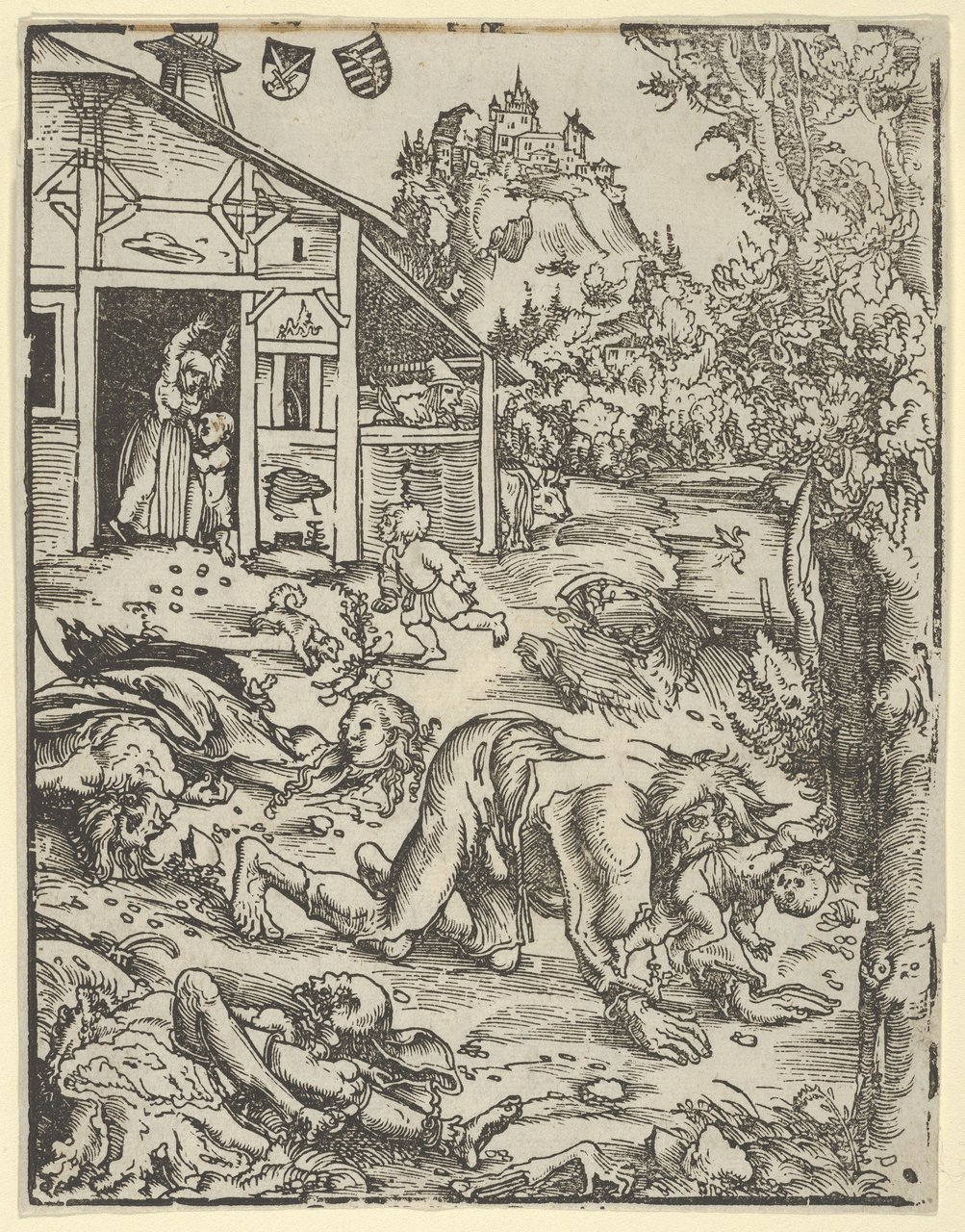
Europe's most durable shapeshifter is the werewolf, and its very name is a plain compound: the Old English wer, meaning man, joined to wulf. Its oldest recorded case is a punishment, and it comes straight out of the same Ovidian poem we started with. Lycaon, a king of Arcadia, serves human flesh at a banquet to test the gods, and Zeus answers by turning him into a wolf. Lycaon's name is still on the condition: lycanthropy, the werewolf transformation, is named for him. The catalogue of transformations and the monster of a thousand horror films share a single Roman root.
From there the tradition splits into the voluntary and the ecstatic. The earliest detailed account of a man choosing to become a wolf is in the Satyricon of Petronius, written around 60 CE: a soldier strips naked at a crossroads, urinates in a circle around his own clothes, and turns into a wolf before a witness's eyes. Farther north the change is a battle-fury rather than a spell. The Norse berserkers, whose name means bear-shirt, and the ulfhednar, the wolf-skins, were warriors said to enter a trance in which they became, or at least fought as though they had become, bears and wolves; Snorri Sturluson describes them in the sixth chapter of his Ynglinga Saga.
And then, for two centuries, the werewolf left mythology and stood trial. Across Early Modern Europe, from the fifteenth to the seventeenth century, werewolf trials ran alongside the witch trials, with real defendants, real courts, and real sentences. Three of them are documented by name, and they were not one generic case retold but three distinct people in three distinct places, whose records still survive.
| Defendant | Place and year | What the record says |
|---|---|---|
| Peter Stumpp | Cologne, 1589 | Executed for allegedly transforming into a wolf and committing serial murder |
| Jean Grenier | Bordeaux, 1603 | A teenager who confessed to lycanthropy; sentenced to life in a monastery rather than to execution |
| Thiess of Kaltenbrun | Livonia, 1692 | Claimed to be a 'Hound of God' who fought witches as a werewolf; studied at length by Carlo Ginzburg in The Night Battles (1983) |
06The Selkie: The Skin On The Beach
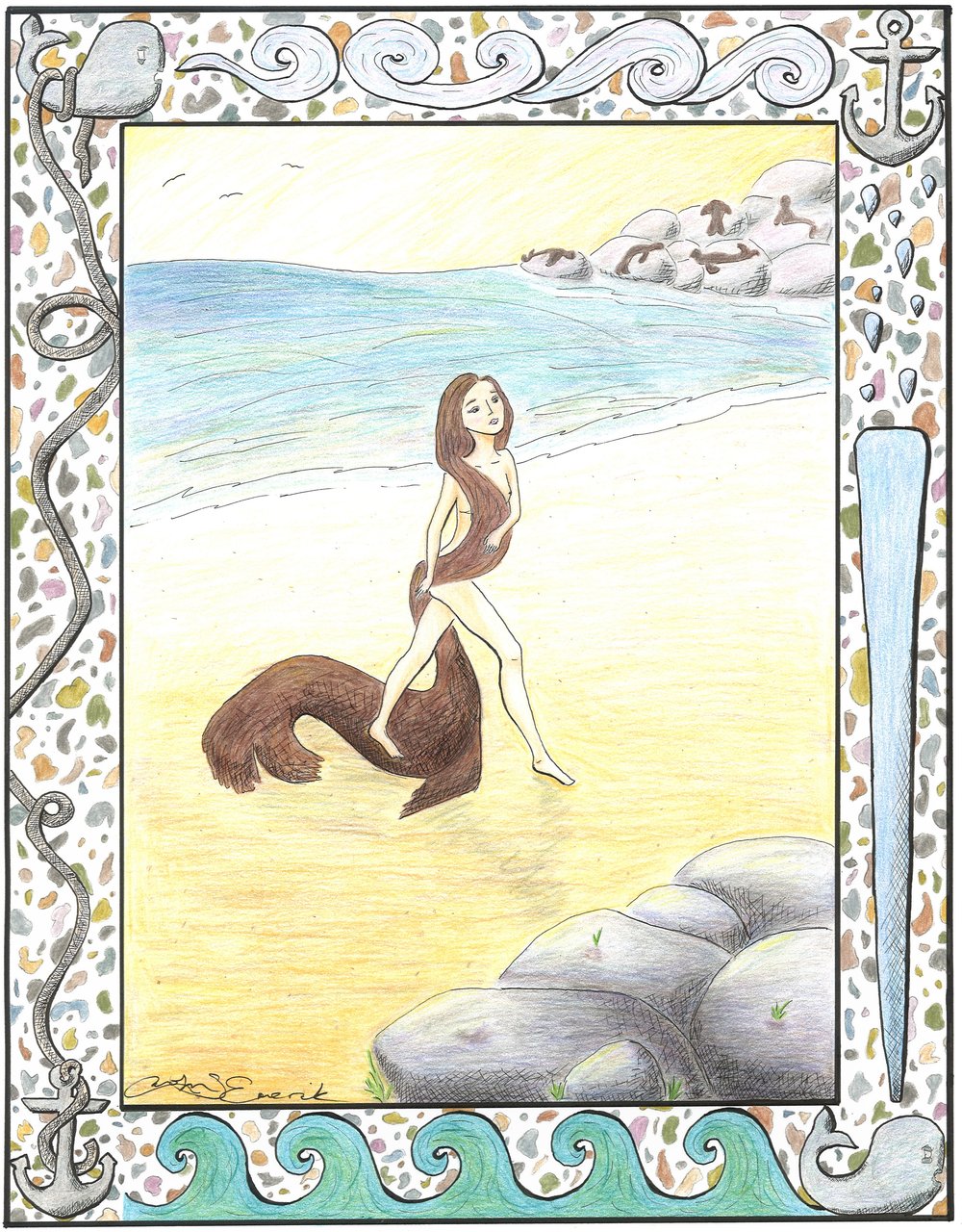
Move to the cold coasts of the North Atlantic and the shapeshifter turns gentle and heartbreaking. The selkie, from the Orkney dialect word selch for seal, is a seal that can shed its skin and step out of it as a human being. The tradition belongs to Orkney, Shetland, the Faroe Islands, Iceland, and Scotland, and the story it tells is almost always the same. A man walking the beach finds a seal-woman's discarded skin, hides it, and marries her. She lives with him as a wife and bears his children, and for years it holds. Then one day she finds the skin again, often because one of her own children turns it up without knowing what it is, and the moment she has it back she returns to the sea, sometimes surfacing afterward to watch the children she left on the shore.
It is hard to miss what that story is about. The selkie tale encodes captive marriage, a longing for a freedom that domestic life cannot contain, and the flat incompatibility of the wild and the settled, and it has often been read as a parable of women's restricted lives in the tight patriarchal world of a fishing community. It is also not a dead folktale. David Thomson, in The People of the Sea, first published in 1954, collected selkie stories directly from living oral tradition in Scotland and Ireland, proof that the seal-woman was still swimming through people's telling well into the twentieth century.
07The Traditions That Are Not Myths
Two more traditions belong in this survey, and they require a different kind of care than the ones before them, for a reason the research file states plainly and we will not soften. The shapeshifter traditions of living Indigenous cultures are not simply myths waiting to be catalogued alongside Ovid and Loki. They are active spiritual systems, held by people who are alive right now, with real consequences inside the cultures that hold them. And the record of outsiders studying them is not clean: academic attention has at times broken the cultures' own protocols and fed a sensationalist popular-culture machine that strip-mines these beliefs for scares. So the two that follow are reported briefly, in their own terms, and pointed toward fuller and more careful treatment rather than mined for atmosphere.
The first is the Navajo yee naaldlooshii, a name that translates as 'with it, he goes on all fours.' It is a human being who takes an animal's shape, most often a coyote, wolf, owl, or crow, by wearing that animal's skin. The single most important thing to understand is what it is not. It is not a mythological creature in the Western sense, a monster to be enjoyed. Within Navajo cosmology it is a real moral and spiritual threat, and discussion of it is culturally restricted; many Navajo people are uncomfortable with the subject being publicized at all. For that reason this file states the caution and stops there. The full treatment, handled with the seriousness the tradition is owed, lives in our dedicated article on the skin-walker and the wendigo. Even the first major outside ethnography, Clyde Kluckhohn's Navaho Witchcraft of 1944, is itself criticized for insufficient cultural sensitivity, which is exactly why the fuller account belongs where it already carefully sits, and not here.
The second is the nagual of Mesoamerica, from the Nahuatl nahualli, meaning disguise or concealment. The word names two linked things. First, a personal animal alter-ego that every person is born with, bound to them by a shared fate, so that a wound to the animal is a wound to the human. Second, a sorcerer with the deliberate power to transform into that animal, most often a jaguar, an eagle, or a coyote. The belief is documented across Mesoamerica, among the Aztec, Maya, Zapotec, and Mixtec, and it did not die with the empires; it survives in Indigenous communities in Mexico and Guatemala today. The most comprehensive study of it is Alfredo Lopez Austin's Cuerpo humano e ideologia, published by the National Autonomous University of Mexico in 1980. Like the yee naaldlooshii, the nagual is a living idea, not a fossil, and it earns the same care.
08Why The Mind Keeps Making Them
Step back from the individual traditions and a fair question presents itself: why this figure, everywhere? One answer comes from the cognitive science of religion. Pascal Boyer, in Religion Explained (2001), argues that a shapeshifting story hijacks a specific piece of mental machinery, the evolved system we all use to track identity, to keep straight who is who. That system runs on a deep assumption: a person's physical form is permanent, and the body in front of you now is the body that will be in front of you tomorrow. A being that changes shape violates that assumption directly, and the violation is precisely what makes the story stick. It grabs attention, it lodges in memory, and it gets retold.
Scott Atran sharpens the point in In Gods We Trust (2002). A shapeshifter, he notes, is minimally counterintuitive: it breaks exactly one expectation, the physical permanence of form, while keeping all the others intact. The fox that becomes a woman still has a single continuous identity, still wants things, still remembers. It is strange in one load-bearing way and ordinary in every other, and that ratio is the sweet spot for cultural transmission, odd enough to be worth repeating and coherent enough to be repeatable. Which is why the research file lands where it does, on a single idea that runs under all five traditions at once: identity is not fixed, the boundary between human and animal is permeable, and power lives in the ability to cross categories rather than to stay inside one. The shapeshifter, on this reading, is the mythological embodiment of liminality, the state of being between defined things.
09The Cave And The Clinic
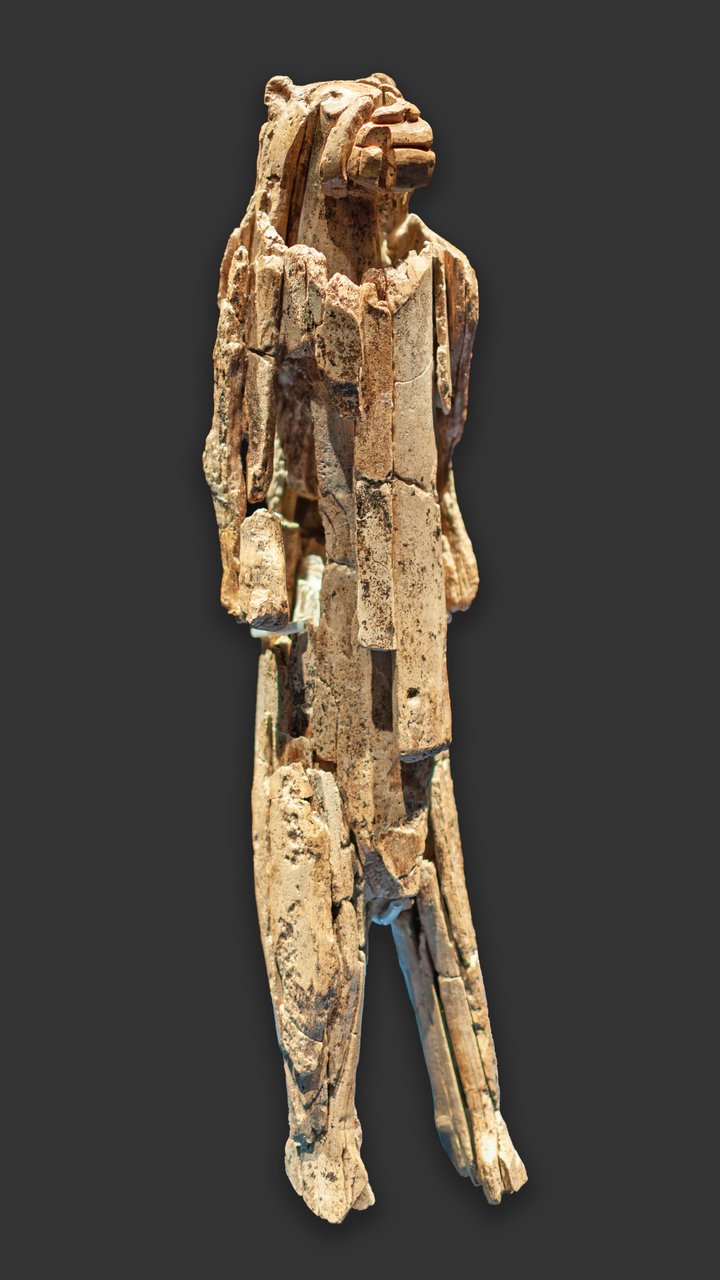
Two further explanations reach past the texts, and both have to be held more loosely, at the file's own Tier 3. The first reaches very far back. Upper Paleolithic art includes therianthropes, figures that fuse a human body with animal parts, and two are famous. The Sorcerer painted in the Trois-Freres cave in France dates to roughly 13,000 BCE, and the Lowenmensch, the lion-headed human figure carved from mammoth ivory and found at Hohlenstein-Stadel in Germany, is older still, around forty thousand years old. Those objects are real, and their dates are well established; that part is not in dispute. What is speculative is what they mean. David Lewis-Williams, in The Mind in the Cave (2002), reads them as depictions of shamanic transformation, records of an experience of becoming an animal in an altered state of consciousness. That is a serious hypothesis about the origin of the whole shapeshifting idea, and it is a hypothesis, not a caption the ivory came with.
The second explanation reaches into the clinic. Clinical lycanthropy is a real and rare psychiatric condition in which a person genuinely believes they are turning into an animal, documented in the modern literature and typically tied to psychosis, bipolar disorder, or severe depression. Some researchers speculate that historical werewolf and skin-walker beliefs arose partly from encounters with people in the grip of exactly this condition. Notice the care in that sentence, which is the file's own care: speculate, and partly. This is offered as one contributing thread in a much larger weave, not as the solution that dissolves the tradition. A single psychiatric diagnosis does not explain Ovid, or Loki, or the selkie, and the file does not pretend it does.
10The Claim We Refuse
For all that range, one claim gets a flat refusal, and the file does not hedge it. There is no evidence that a human being can physically become an animal through occult practice, no biological metamorphosis of a person into a wolf or a fox or a bird, not once, anywhere, under any tradition. Every documented experience of transformation is psychological in nature: an altered state of consciousness, an episode of clinical lycanthropy, a dissociative break. That is not a hostile reading forced on the material from outside; it is simply where the evidence stops. The bodies do not change. The minds that believe they do are the real and fascinating phenomenon, and they are more than enough.
11The Word That Groups Too Much
There is a last caution to raise before closing, and it is one the research file raises against itself. The single word shapeshifter, useful as it is, may quietly be committing an error of grouping. Look at what it has been asked to cover in this file alone. Zeus becoming a swan is an exercise of divine power. Lycaon becoming a wolf is a punishment. The yee naaldlooshii taking an animal's form is spiritual warfare inside a living cosmology. The selkie's seal-skin is a romantic tragedy about captivity and loss. Loki becoming a mare is trickster chaos. These are not five versions of one thing. They are five genuinely different phenomena that happen to share a surface feature, and lining them up under one English noun can manufacture a false equivalence that none of the source cultures would recognize.
| The transformation | The tradition | What kind of act it really is |
|---|---|---|
| A god takes any form he likes to seduce a mortal | Classical (Zeus) | Divine power, exercised at will |
| A king is sentenced to a wolf's body for a monstrous crime | Classical (Lycaon) | Punishment |
| A trickster slips through species and sex to escape and to sabotage | Norse (Loki) | Trickster chaos |
| A seal-woman is held as a wife until she recovers her skin | Scottish and Nordic (selkie) | Romantic tragedy |
| A person takes an animal's shape to do harm | Navajo (yee naaldlooshii) | Spiritual warfare in a living cosmology |
Fast Facts
- The claim
- The shapeshifter may be the single most universal motif in all of mythology, turning up in every culture that left enough material to check
- Ovid
- The Metamorphoses, fifteen books and more than 250 transformations, is the largest shapeshifting compendium in world literature
- Loki
- Became a salmon, a fly, a flea, and an old woman, and as a mare gave birth to Sleipnir, Odin's eight-legged horse
- The kitsune
- A Japanese fox gains human form at 50 or 100 years; the nine-tailed kyubi is near-divine, and over 32,000 Inari shrines are guarded by stone foxes
- The werewolf
- From Lycaon in Ovid to three documented trials: Peter Stumpp (Cologne, 1589), Jean Grenier (Bordeaux, 1603), and Thiess of Kaltenbrun (Livonia, 1692)
- The selkie
- A seal that sheds its skin to marry a human, read as a parable of captive marriage and lost freedom (Thomson, 1954)
- The living traditions
- The Navajo yee naaldlooshii and the Mesoamerican nagual are active spiritual systems, not catalog-ready myths, and are treated here with that care
- The thesis
- The shapeshifter is the embodiment of liminality: identity unfixed, the human-animal line permeable, and power in the crossing
- Tier 4
- Literal biological shapeshifting through occult practice is unsupported; every documented transformation is psychological
What We Can Actually Stand Behind
The five great traditions rest on documented primary texts and the historical record. Ovid's Metamorphoses and Proteus of the Odyssey are named, translated sources; Loki's transformations are in the Prose Edda and the Sorla thattr; the kitsune is carried by the Konjaku Monogatarishu and the Tamamo-no-Mae legend, and guarded by more than thirty-two thousand Inari shrines; the werewolf runs from Lycaon and Petronius to three named, dated trials, Stumpp in 1589, Grenier in 1603, and Thiess in 1692, the last studied by Carlo Ginzburg; and the selkie was collected from living oral tradition by David Thomson. None of that is in doubt.
The living traditions and the cognitive account are credible and correctly kept one step back. The Navajo yee naaldlooshii and the Mesoamerican nagual are real spiritual systems, reported here only briefly and pointed toward their fuller treatment, and the cognitive-science reading, Boyer's identity-tracking module and Atran's minimally counterintuitive beings, is academically supported but still argued in its specifics. Two named cautions ride alongside, and both belong in the file rather than as afterthoughts: that these are living cultures and not a catalogue to be strip-mined, and that the word shapeshifter itself may force a false unity onto radically different acts.
Two explanations sit further out. The Upper Paleolithic therianthropes, the Trois-Freres Sorcerer at roughly 13,000 BCE and the Lowenmensch at around forty thousand years old, are real, dated artifacts; that they depict shapeshifting belief is Lewis-Williams's interpretation, not a fact the ivory states. And clinical lycanthropy is a genuine psychiatric condition, but the claim that it helped seed the historical traditions is offered only as a partial hypothesis, 'researchers speculate' and 'partly,' not a settled cause. Hold both as questions worth asking, not answers.
One claim is refused outright. There is no evidence that a human body can biologically become an animal through occult practice, and reading any tradition as literal metamorphosis is unsupported. Every documented transformation experience is psychological: altered states, clinical lycanthropy, dissociative episodes. To that, the honest answer is a plain no.
So the shapeshifter turns out to be less a creature than a question every culture asked in its own words. The Greeks asked it as divine power, the Norse as trickery, the Japanese as seduction and the sacred at once, the Scots as grief, the Navajo as a warning too serious to be called a story. Flatten all of that into one word and you lose exactly what each tradition was trying to say, which is why the research file warns against the word even while it uses it. What survives the flattening is the shape underneath: an old suspicion, one that some archaeologists read all the way back into ice-age ivory, that the boundary between us and everything else that breathes is thinner than it looks, and that whoever learns to cross it comes back changed and holding something the rest of us were never allowed to have. When the next story hands you a person who slips into an animal's skin and out again, are you watching a monster, or are you watching the oldest wish there is, the wish to not be only one thing?
Sources & further reading
Everything above is drawn from our research library on Theories of Anything, which is where we worked from. The papers, reports and primary records listed beneath them are where you can check us independently.
Image credits
- Apollo and Daphne, Gian Lorenzo Bernini (1622-1625), Galleria Borghese, Rome period photograph by James Anderson, via Wikimedia Commons. Public domain Source.
- Loki with a fishing net, 18th-century Icelandic manuscript SAM 66 via Wikimedia Commons, Arni Magnusson Institute, Iceland. Public domain Source.
- Tamamo-no-Mae at the Death Stone of Nasu Moor, woodblock print by Tsukioka Yoshitoshi (1891) via Wikimedia Commons. Public domain Source.
- The Werewolf, woodcut by Lucas Cranach the Elder, circa 1512 via Wikimedia Commons. Public domain Source.
- The Lowenmensch (Lion Man) figurine, Hohlenstein-Stadel, Germany, Museum Ulm photograph by Dagmar Hollmann, via Wikimedia Commons. CC BY-SA 4.0 Source.
- Selkie, illustration by Carolyn Emerick (2013) via Wikimedia Commons. CC BY-SA 3.0 Source.
- Card crop of Apollo and Daphne, Gian Lorenzo Bernini (1622-1625), Galleria Borghese, Rome period photograph by James Anderson, via Wikimedia Commons. Public domain Source.
.jpg)


