The Belgian Wave, 1989 to 1990: The Famous Photograph Was Polystyrene, and the Case Is Still Open
Start with the picture, because the picture is what everybody remembers and the picture is a fake. A black triangle against a night sky with a light burning at each corner, taken at Petit-Rechain in April 1990, reproduced across Europe for two decades as the best photographic evidence a UFO wave had ever produced. In July 2011 the man who made it walked into a Belgian television studio and showed how: a sheet of expanded polystyrene cut into a triangle, painted black, a lamp fixed at each corner, hung on a string. You will not find that photograph anywhere on this page, at any size, and the paragraphs just below explain why we refuse to print it even with a caption calling it a hoax. What is genuinely interesting is everything that does not fall with it. Between November 1989 and April 1990 thousands of people across Belgium reported triangular objects. Two gendarmes near Eupen followed one for about half an hour. The Belgian Air Force scrambled two F-16s, then held a press conference and showed the country its own mission tapes. And Belgium's own Electronic War Centre later worked out what most of those radar readings actually were, a finding the case's own lead scientist accepted while still calling the wave unexplained. A hoaxed photograph says nothing whatsoever about a policeman's sworn report or about what a mission recorder wrote to tape. This is what is left when you take the famous picture off the table.
Almost everyone who knows anything at all about the Belgian wave knows one photograph. A black triangle against a night sky, a white light burning at each corner, a glow in the middle. It was taken at Petit-Rechain in April 1990. It was on television and in print across Europe within months, and for two decades it was described as the best photographic evidence any UFO wave had ever produced. It was a piece of packing foam on a string.
That is the first sentence on this page rather than a correction buried in section eight, and it is deliberate. So is the second decision: you will not see the photograph here. Not cropped, not at thumbnail size, not sitting under a caption that calls it a hoax. The object in that frame was manufactured to deceive, and printing it at the size of evidence hands a reader the exact thing this dossier exists to take off the table. Prose can carry a hoax honestly. A picture cannot carry it without also carrying its glamour.
Then comes the harder job, and it is the real work of this article. Deleting that photograph deletes one evidence class from the Belgian wave and leaves three others standing, and they must not be allowed to fall with it. Thousands of ordinary people. Two policemen at close range with a report to file. Two F-16s, three radar locks, and a national air force that turned around and showed the country its own mission tapes. What follows keeps those three apart, each at its own weight, plus the thing our own research file never told us: what Belgium's own analysts eventually concluded about Belgium's own radar data.
01The Photograph, And The Man Who Made It
[DEBUNKED] The famous photograph showing a triangular craft with three lights, allegedly taken on April 4, 1990, in Petit-Rechain by an anonymous witness ('Patrick'), was revealed by its creator (identified in our file only as 'Patrick M.') in July 2011 as a hoax, constructed using polystyrene, painted black, with small lights, and photographed against the night sky.
Our file anonymises him. The public record does not, because he did not anonymise himself. In July 2011 the man appeared on the French-language Belgian broadcaster RTL, gave his name as Patrick Marechal, and demonstrated the method on camera. A sheet of expanded polystyrene, cut into a triangle. Painted black. A light fixed at each corner. Suspended on a string and photographed against the night sky. He said he had been around eighteen to twenty years old at the time and had done it with workmates. The picture was taken in April 1990 and then sat for about four months before it was released at all.
The confession was verified by SOBEPS researchers and is not disputed. The image had been widely reproduced as the 'best' photographic evidence of the Belgian wave.
One precision on our file's wording, in the direction of caution rather than away from it. It says the confession is 'not disputed.' The sentence this page will stand behind is that it is not credibly disputed. What stands is a filmed demonstration of the fabrication method, given by the man who made the object, and this page treats that as settled unless something with a traceable primary source is ever set against it. The distinction matters because it is the same standard the rest of this page applies to the material that survives.
Now be precise about what the hoax costs the case, because the cost is real and it is also bounded. What is gone is the one piece of physical-looking evidence, the image that let a reader feel they had seen the thing themselves. What is not gone is anything that happened on the ground or in the air. The photograph was taken in April 1990, four months after the wave started and days after the F-16 scramble, and it was withheld for about four months after that. It did not produce the reports. It arrived late to a case that was already national news. Nothing in the Eupen file and nothing on a mission recorder depends on it in any way.
02Eupen, 29 November 1989
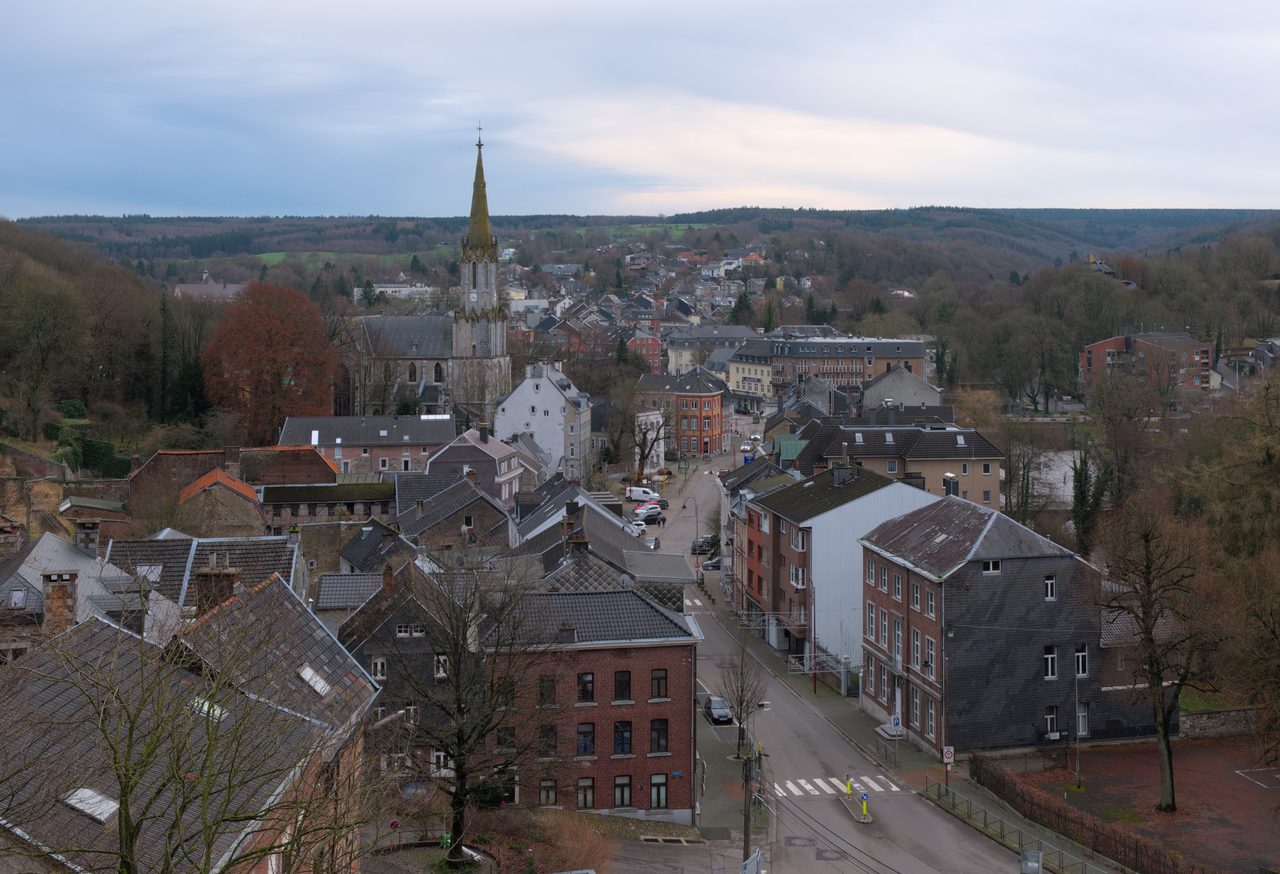
On November 29, 1989, gendarmes Heinrich Nicoll and Hubert von Montigny observed a large triangular platform with three bright lights and a central pulsating red-orange light at low altitude, estimated at roughly 300 to 500 metres, near Eupen in eastern Belgium. The object moved slowly and silently. They followed it for approximately 30 minutes, making multiple stops to observe.
Two men on a shift, in a car, in the far east of the country, near the German border. They did not chase it once and drive off. They followed it for about half an hour and stopped repeatedly to look, which is the behaviour of people trying to make sure of something rather than people telling a story. Then they filed. That is what a gendarme report is: an account written down by someone whose job made them write it down, at the time, with their name on it. It is not proof of anything about the object. It is a document, and documents are the reason this case is worth an article at all.
The gendarmes' report was independently corroborated by approximately 30 groups of witnesses along the Eupen to Verviers to Liege corridor that evening. Witness descriptions were remarkably consistent: a large triangle, three white lights, a central red light, silent, slow-moving.
This is the second thing the photograph never touched, and it is worth being exact about what it does and does not establish. Thirty separate groups along one corridor on one evening, converging on the same description, rules out any account in which two policemen invented something. It does not rule out an account in which many people were looking at the same ordinary thing and reading it the same wrong way, and section 07 puts that argument at full strength. Consistency is evidence that something was seen. It is not, by itself, evidence about what.
Auguste Meessen, a physicist at UCLouvain, conducted extensive interviews and analysis. He calculated that the object's angular size and apparent distance were consistent with a genuinely large structure, roughly 30 metres or more in span.
Read that for what it is. It is a calculation from testimony, not a measurement of an object. Angular size is a real quantity and the arithmetic is honest, but it takes the witnesses' distance estimate as its input, and if the distance was wrong the span is wrong by exactly the same factor. Meessen will matter a great deal later in this article, and he will matter for a reason that is the opposite of this one, so hold the name.
03The Numbers, And Whose Numbers They Are
SOBEPS compiled over 2,000 detailed witness reports during the wave period and published two volumes, Vague d'OVNI sur la Belgique, volume 1 in 1991 and volume 2 in 1994, containing witness testimony, radar analysis and physical investigation.
The volumes are real and so is the scale of the work. The count is where our file slips, in the ordinary way that big numbers slip: a figure that counts one thing gets restated as if it counted a harder thing. Our file's summary also states that an estimated 13,500 people reported sightings to SOBEPS. That figure is attached, in the wider record, to a different quantity entirely, and the difference between the two versions is the difference between 'thousands of people filed reports with a civilian research group' and 'thousands of people saw something on one particular night.' Only the second one happened. Here is the breakdown as the record actually carries it.
| The Figure | What It Actually Counts | Where It Comes From |
|---|---|---|
| About 13,500 | Estimated ground witnesses on the single night of 30 to 31 March 1990. Not people who filed anything with anybody. | The commonly reported breakdown of the wave, verified independently for this page. Our own file attaches this number to people reporting to SOBEPS, which is a different quantity. |
| About 2,600 | Written statements SOBEPS received across the whole wave. | SOBEPS's own accounting. |
| About 2,000 | Reported cases logged. | SOBEPS's own accounting. Our file describes these as 'detailed witness reports,' which is the same number doing a bigger job than it can hold. |
| About 650 | Of those cases, the number SOBEPS collected evidence for and worked in detail. | SOBEPS's own accounting. |
| About 500 | Of those worked cases, the number left unattributed to any known cause. | SOBEPS's own accounting, and this is the row where being the interested party matters most. |
| About 30 groups | Independent witness groups corroborating the gendarmes along the Eupen to Verviers to Liege corridor on the evening of 29 November 1989. | Tier 2 in our own file. |
| Over 1,000 pages | The two-volume SOBEPS report, from a formal investigation that ran from 1989 to 1993. | Volume 1, 1991; volume 2, 1994. |
The SOBEPS investigation represents one of the most comprehensive civilian scientific investigations of a UAP event, though SOBEPS was a civilian organisation and its work was not peer-reviewed in the traditional sense.
Our file supplies its own caveat there, in the same sentence as the compliment, and both halves are staying. Five hundred cases left unattributed sounds enormous until you notice who decided they were unattributed, and it was the organisation that existed to investigate them. That is not an accusation of bad faith. It is the reason a figure like that belongs at Tier 2 with its provenance attached rather than at Tier 1 as a bare fact.
04The Night Of 30 To 31 March 1990
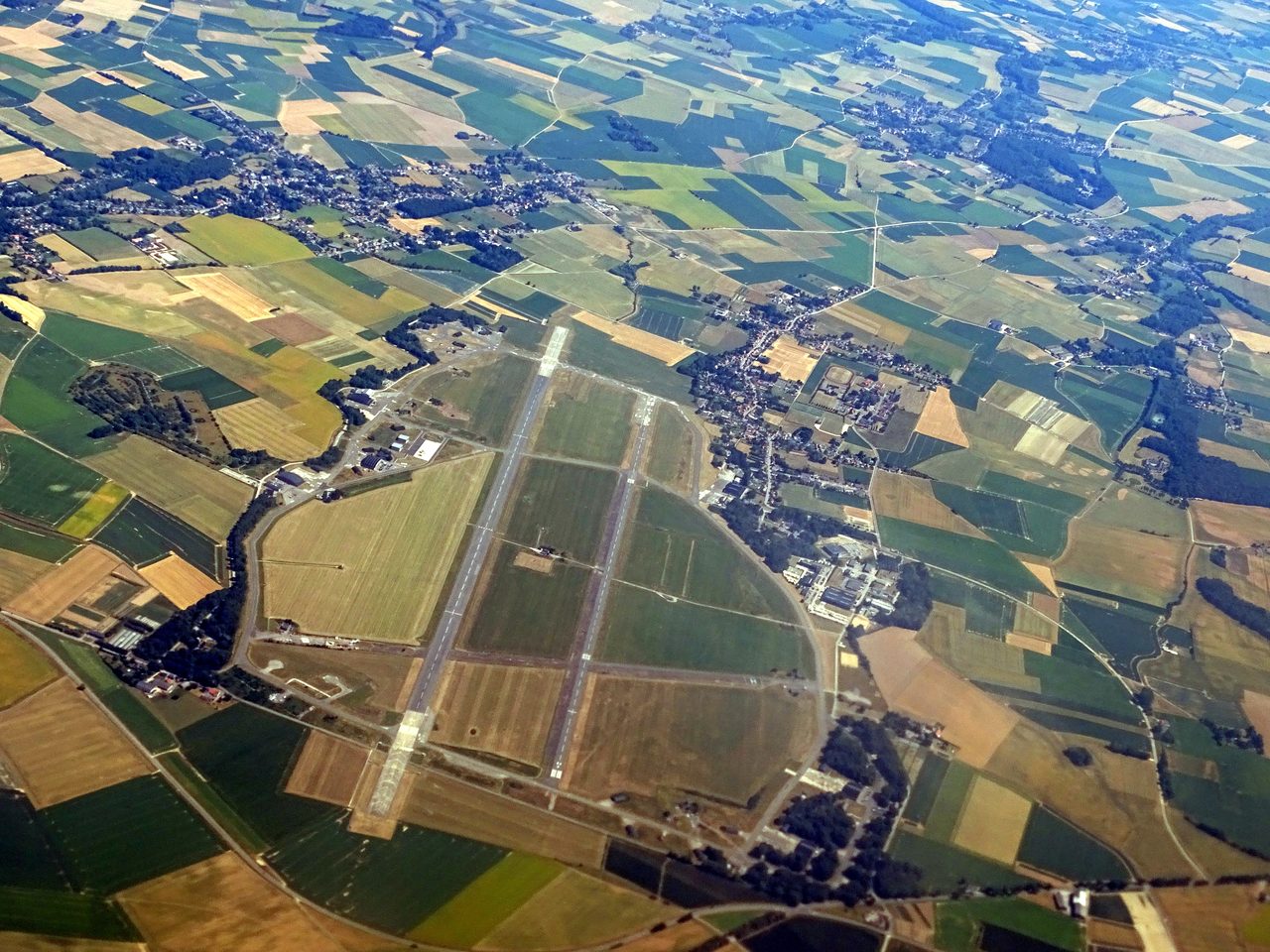
Two F-16 Fighting Falcons from the 1st Fighter Wing at Beauvechain Air Base were scrambled at approximately 00:05 on March 31, 1990, after NATO NADGE ground radar and multiple gendarmerie posts reported unknown contacts over the Wavre area.
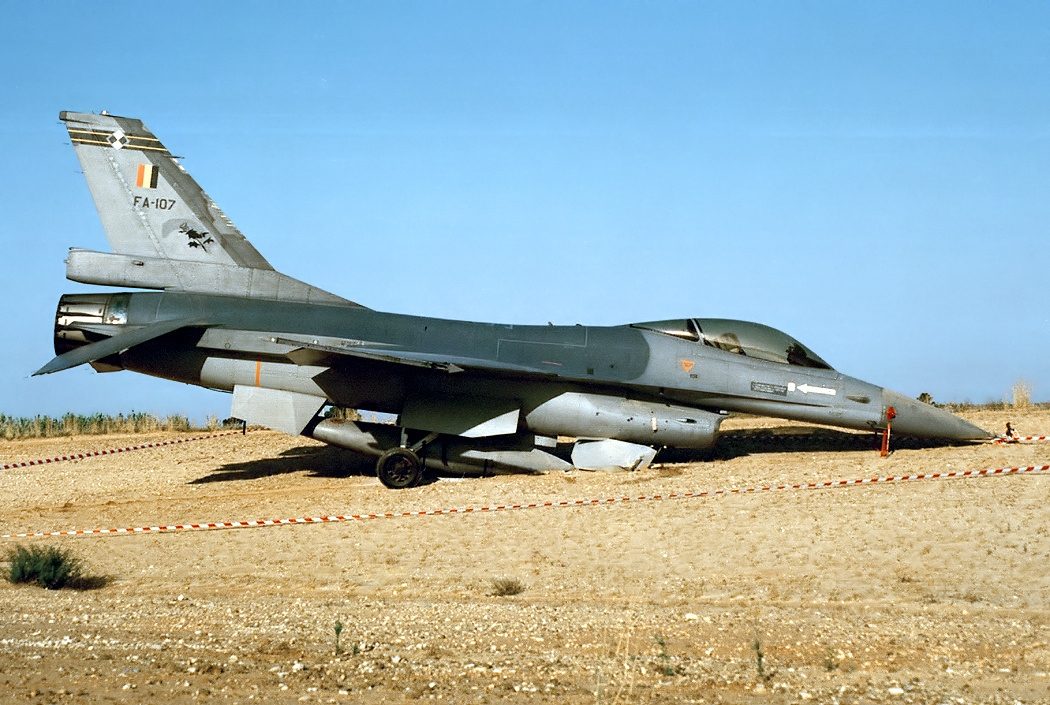
Our file gives that as one approximate time. The Belgian Air Force wrote down a sequence, and the sequence is better than the summary in one specific and slightly unsettling way: the thing that started it was a gendarme on a telephone describing three unusual lights in an equilateral triangle. That is the Eupen description, four months later and well to the west across the country, coming into a military radar station from a police line.
| Time | What The Record Says | Notes |
|---|---|---|
| Evening, 30 March 1990 | The gendarmerie telephones the Glons radar master controller to report three unusual lights forming an equilateral triangle. | Glons is an air defence radar site east of Brussels. The description matches Eupen four months earlier. |
| 23:49, 30 March | The NATO facility at Semmerzake detects an unknown target. | Semmerzake is a military air traffic control station west of Brussels. |
| About 23:56, 30 March | The scramble order is issued. | From the same chronology. |
| Shortly after midnight | Two F-16s launch. | Our file gives the launch as approximately 00:05 on 31 March, from the 1st Fighter Wing at Beauvechain. The two accounts are compatible. |
| About 00:07 to about 00:54, 31 March | Interception attempts, with brief radar locks. | From the same chronology. |
| Throughout | The pilots never obtain visual contact. | Nothing was seen from either cockpit at any point in the intercept. This is the single most important line in the document. |
Sit with that last row before reading the next claim, because it frames everything that follows. Two pilots flew for roughly three quarters of an hour toward things their instruments insisted were there, in clear enough conditions to be sent, and neither of them ever saw anything at all. Their radars recorded everything. Their eyes recorded nothing. That gap is not a detail. It is the exact shape of the question that section 06 answers.
The F-16s acquired radar lock three times on targets that displayed extraordinary kinematics as recorded: a target accelerating from near-stationary to about 1,000 knots in seconds; a target executing a descent from about 10,000 feet to near-ground level in approximately two seconds; and manoeuvres that exceeded the tracking capability of the F-16's AN/APG-66 radar, breaking lock repeatedly.
Every word of the grammar in that claim is load-bearing, and this page is going to be pedantic about it once so it never has to be again. A radar recorded an acceleration. An object did not accelerate. Those are different sentences and only the first one is supported. The recorded figure of about 1,000 knots is roughly 1,150 miles per hour, if that helps, and a recorded drop of about 10,000 feet in about two seconds is not a manoeuvre any airframe survives. Which is why the honest reading was never 'something extraordinary flew over Belgium.' It was always 'something extraordinary is on this tape, and the first question is whether the tape is describing an object.'
The radar data, pulse Doppler returns, was recorded on the F-16s' onboard mission recorders and publicly presented by De Brouwer. Radar experts have debated whether the returns represent genuine physical targets or electronic artifacts: ground clutter, sidelobe returns, or atmospheric refraction effects in the pulse Doppler processing.
Our file states that debate and then stops, leaving the reader with unnamed 'radar experts' arguing forever. It is not open in the way that implies, and section 06 says who closed it and how. First, though, one remark that belongs to this moment rather than to the later one. Presenting the data, the officer in charge publicly noted that the recorded acceleration worked out at about 40 G, which he said would exclude a human pilot on board, since a person can withstand only about 8 G. That is a real inference and it was made in good faith, and it inherits everything that happens to the readings it is calculated from. If the readings are echoes, the 40 G describes the behaviour of a patch of air.
05What The Air Force Did Next
The Belgian Air Force officially acknowledged the events and cooperated with SOBEPS, the Belgian civilian UFO investigation organisation. De Brouwer's press conference on July 11, 1990 presented the F-16 radar tapes, an act of institutional transparency our file describes as unmatched by any other military in a UAP context.
Two corrections to that, one about a man's rank and one about a superlative. Wilfried De Brouwer held the rank of Colonel during the wave and at the press conference, serving as Chief of Operations of the Air Staff. He was promoted Major General, and served as Deputy Chief of the Belgian Air Force, later in his career, and he is a retired Major General today. Our file calls him Major General acting in 1989 and 1990, which projects a later rank backwards onto the events, and rank is doing real rhetorical work in an argument about how senior the transparency went. He was a Colonel. It was still remarkable. As for 'unmatched by any other military,' that is our own file's assessment rather than the result of a survey anybody ran, and it travels here as an assessment.
The press conference itself was held on July 11, 1990 at NATO headquarters at Evere in Brussels. He acknowledged that the objects were unidentified, presented the radar data to journalists, and stated that the performance characteristics detected went beyond the possibilities of existing technology. That was his assessment in 1990. Keep the date attached to it, because the analysis that changes how it reads had not been done yet.
There is also a document our file never mentions, not in its text and not even in its bibliography, and it is the closest thing to a primary source this case has. The Belgian Air Force produced a written report on the night of 30 to 31 March 1990. An abridged version, titled 'Report Concerning the Observation of UFOs During the Night of March 30 to 31, 1990,' was prepared by Major P. Lambrechts of the Air Force General Staff and released to SOBEPS. It carries the chronology in the table above, and it explicitly dismisses several candidate explanations, naming optical illusions, meteorological inversions and holographic projections among them. The complete report has never been fully declassified. A civilian research group was handed a military staff report on a military operation, and the military wrote down what it had already ruled out.
That is the argument that survives the hoax entirely intact, and it is worth stating plainly because it is the reason this case still matters. The Belgian wave's significance lies not in proving any specific hypothesis but in the quality of the documentation: official military cooperation, sworn gendarmerie reports, and radar data presented publicly. That transparency allows meaningful analysis that is impossible with most UAP cases. It is also, as the next section shows, exactly what allowed the case to be substantially resolved. An air force that shows its working can be checked, and being checkable cuts both ways.
06Belgium Answered Its Own Question
This is the section our research file does not have, and it is the reason this page exists in the form it does. An article that reports the recorded figure of about 1,000 knots and then leaves the reader with 'radar experts have debated' would be leaving that reader with a false impression, because the people best placed to settle it settled it, and they were Belgian.
Belgium's own Electronic War Centre carried out a detailed technical analysis of the F-16 mission tapes. It was completed by Colonel Salmon and the physicist M. Gilmard around 1992, and its conclusion was that the radar contacts were 'angels': false echoes produced by a rare meteorological condition. Cells of warm humid air, under high humidity and wind, at around 10,000 feet, with a slight temperature inversion. In radar terms that is the Bragg scattering class of clear-air echo: a return in which the atmosphere itself, rather than an object, sends the signal back. The analysis found something else too, and it is the detail that ends the argument. Four of the lock-on events the Centre analysed computed to a negative altitude, the Centre having worked the night's full set of contacts rather than only the three locks the intercept record documents. The apparent target was below ground level, which no physical object can be, and the ground acting as a mirror accounts for it.
Read that once more slowly. Four times, the equipment reported a solid lock on something underneath Belgium. There is no craft, secret or otherwise, that can be located beneath a field, and there is no interpretation of that number that leaves an object in the sky. What there is, is a radar being fooled by the atmosphere in a way that also produces spectacular apparent speeds and impossible apparent dives, because a signal bouncing between air cells and the ground can appear to move at any velocity you like. The extraordinary kinematics and the negative altitudes are the same artifact seen from two angles.
And then the part that decides how much weight this carries. Auguste Meessen, the physicist who had done the wave's scientific analysis for SOBEPS, reviewed the Electronic War Centre's work, and he and SOBEPS accepted the Gilmard and Salmon hypothesis. The civilian organisation that had spent years building the case against a conventional explanation looked at the air force's analysis of the air force's own tapes and agreed with it. That is not a debunking imposed from outside. That is the case's own scientists conceding the strongest instrumental evidence they had.
One further detail is widely repeated and this page carries it with its hedge attached rather than dropping it or laundering it. It is widely reported that SOBEPS claimed nine radar locks during the night while the Belgian military documented three, and that on analysis all three of those military locks turned out to be locks on the other F-16, with the remaining contacts attributed to Bragg scattering. The trail for that specific claim runs to a secondary skeptical source rather than to any Belgian Air Force paper, and no primary military document stating it could be located, so it stays a report about the analysis and not a finding from it. The Electronic War Centre conclusion above does not depend on it in any way.
Now the sentence that makes this article worth reading, and it belongs to Meessen. He accepted the atmospheric account of the radar echoes. He has also continued to hold that the Belgian UFO wave as a whole is unexplained, and he has noted that at least one radar trace has no explanation to date. Those two positions sit together without strain, and anyone who wants to present him as a debunker or as a believer has to break one of them to do it.
That posture is the whole point. A man can accept that his instruments were fooled and still say the event is unaccounted for, because the instruments were never what the case rested on. This is what our file gets almost right and then loses. It notes, correctly, that the mass-suggestion explanation addresses the volume of reports but does not account for either the close-range gendarme observations or the F-16 radar data. Half of that sentence no longer holds. The radar data now has a candidate account, produced by Belgium's own analysts and accepted by the case's own scientist. The gendarme observations do not. That is the most honest sentence available about this case, and everything else here is commentary on it.
07The Explanations On Offer
Some analysts, notably Tim Matthews in UFO Revelation (1999), speculated that the Belgian triangle was an advanced NATO or USAF aircraft, possibly related to the rumoured TR-3B or an early stealth demonstrator.
The secret-aircraft hypothesis faces significant problems: no NATO or US stealth aircraft matching the described configuration has been acknowledged; the F-117, operational since 1983, and the B-2, first flown in 1989, do not match the described behaviour of hovering, silent flight and extreme acceleration; and flying classified aircraft over a NATO ally without notification would violate protocol. The USAF and the Belgian Air Force have both denied that any known aircraft was responsible.
Our file states the hypothesis and guts it in the next breath, which is the right shape and the reason both halves appear above rather than just the exciting one. The secret-aircraft idea also has a specific weakness in this case that it does not have elsewhere. It was invented to explain a triangle with three corner lights, and the definitive image of that triangle turned out to be foam. Strip the photograph out and the hypothesis is left explaining a description, not an object, and descriptions are much cheaper to produce.
Skeptics, notably Marc Hallet and Robert Sheaffer, argue that initial genuine sightings, possibly of helicopters or conventional aircraft seen at unusual angles, triggered a media-amplified mass observation event: once the 'triangle UFO' frame was established, subsequent observers interpreted ambiguous stimuli through that frame.
The mass-suggestion explanation addresses the sheer volume of reports but does not account for the gendarme observations at close range or the F-16 radar data.
Hallet and Sheaffer are real analysts making a real argument, and this page attributes the argument to them by name while declining to cite the two specific works our file names for them, because neither could be confirmed to exist. That is a sourcing note, not a slight: the argument is well attested independently of the citations, and section 08 explains why five entries in this file's bibliography are being handled that way.
The sharpest version of the helicopter idea is not theirs, though. The French investigator Renaud Leclet, in his own study of the wave, concluded that the November 1989 Eupen sighting was almost certainly a Bell UH-1 Huey helicopter, and argued that the gendarmes' original account described a low noise rather than the silence later attributed to the object. That is a direct conflict of accounts, not an addition to them: our own file states flatly that the object was silent. This page is not going to pick the reading that suits the story. One investigator's reconstruction says helicopter and says the men heard something. Our file says silent triangle. Both versions are in the record, they cannot both be right about the noise, and a reader is entitled to know that the founding observation of this wave has a contested audio detail sitting at the middle of it.
Notice what the mass-suggestion frame needs in order to work, because it is not nothing. It needs a real initial stimulus, and it needs the media amplification to come after that stimulus rather than before it. On the second point it has a genuine problem in Belgium: the corridor reports on 29 November 1989 came in on the same evening as the gendarmes' own sighting, before any triangle frame had yet been established. On the first point it has a genuine strength: something ordinary in the sky over a border region on a November night is not a difficult thing to arrange.
08What Is Left
Three things happened to this case, and they happened in the worst possible order for anyone who wanted a clean answer. The photograph fell in 2011. The radar fell in about 1992, quietly, in a technical analysis most of the public never heard about and our own research file still does not carry. And the witnesses did not fall at all. What is left is a mass sighting event that is documented beyond dispute, an air force that, on our own file's assessment, behaved better than the institutions in the cases either side of it, and an explanation that covers the instruments and not the people.
One more note about the file behind this page, in the interest of a reader being able to check us. This dossier's source document carries a fourteen entry bibliography with no DOI and no ISBN anywhere in it, and its own corrections block records that two invalid ISBNs were removed rather than replaced with a guess, which is the right call and worth saying out loud. Five of those fourteen entries name works that could not be confirmed to exist at all, and one of the five is load-bearing: the file's closing conclusion, that the officer in charge held the phenomenon to be real but its nature unknown, rests entirely on a 2018 memoir no bookseller or publisher record could be found for. That position of his is well attested from his other public statements, including his own signed chapter in Leslie Kean's UFOs: Generals, Pilots and Government Officials Go on the Record (2010), so this page carries the position and drops the citation.
Fast Facts
- The Wave
- November 1989 to April 1990, across Belgium. Documented in Belgian gendarmerie reports, SOBEPS investigation files and Belgian Air Force records. That thousands of people reported triangular objects during the period is not in dispute.
- The Opening Night
- 29 November 1989 near Eupen, eastern Belgium. Gendarmes Heinrich Nicoll and Hubert von Montigny reported a large triangular platform, three bright lights, a central pulsating red-orange light, at roughly 300 to 500 metres, slow and silent, followed for approximately 30 minutes.
- The Corroboration
- Approximately 30 independent groups of witnesses along the Eupen to Verviers to Liege corridor the same evening, with remarkably consistent descriptions.
- The Photograph
- Petit-Rechain, April 1990. Confessed a hoax on Belgian television in July 2011 by its maker, Patrick Marechal: expanded polystyrene cut into a triangle, painted black, a light at each corner, hung on a string. Verified by SOBEPS researchers. Our file marks it [DEBUNKED]. It is not reproduced on this page.
- The Scramble
- Two F-16 Fighting Falcons from the 1st Fighter Wing at Beauvechain Air Base, launched shortly after midnight on 31 March 1990 after NATO NADGE ground radar and multiple gendarmerie posts reported unknown contacts over the Wavre area.
- What The Radar Recorded
- Three locks documented in the intercept record. As recorded: acceleration from near-stationary to about 1,000 knots in seconds, a descent from about 10,000 feet to near ground level in approximately two seconds, and manoeuvres that broke the tracking capability of the F-16's AN/APG-66 radar. Pulse Doppler returns, held on the onboard mission recorders.
- What The Pilots Saw
- Nothing. No visual contact was obtained at any point during the intercept.
- The Report
- 'Report Concerning the Observation of UFOs During the Night of March 30 to 31, 1990,' an abridged Belgian Air Force document prepared by Major P. Lambrechts of the Air Force General Staff and released to SOBEPS. It carries the chronology and explicitly dismisses optical illusions, meteorological inversions and holographic projections. The full report has never been declassified. Absent from our own file entirely.
- The Press Conference
- 11 July 1990, NATO headquarters at Evere, Brussels. Wilfried De Brouwer, then a Colonel and Chief of Operations of the Air Staff, presented the F-16 radar tapes to journalists and said the detected performance characteristics went beyond the possibilities of existing technology. He was promoted Major General later; our file backdates the rank.
- The Official Analysis
- Belgium's Electronic War Centre analysed the F-16 mission tapes, completed by Colonel Salmon and the physicist M. Gilmard around 1992. Finding: the contacts were 'angels,' false echoes from cells of warm humid air at around 10,000 feet with a slight temperature inversion, the Bragg scattering class of clear-air echo. Four lock-ons computed to a negative altitude, below ground. Auguste Meessen and SOBEPS accepted it.
- The Scientist's Position
- Meessen accepts the atmospheric account of the radar echoes and continues to hold that the wave as a whole is unexplained, noting that at least one radar trace has no explanation to date. Both halves, at once.
- The Numbers
- About 13,500 estimated ground witnesses on the night of 30 to 31 March 1990; about 2,600 written statements to SOBEPS across the wave; about 2,000 reported cases, about 650 worked in detail, about 500 left unattributed. SOBEPS's own accounting, over a formal investigation running 1989 to 1993 and a two-volume report of over 1,000 pages.
- Our Own Confidence
- The research file behind this dossier rates its primary tier at 2 to 3 across a 14-entry bibliography carrying no DOI and no ISBN. Five of those entries name works that could not be confirmed to exist.
So What Actually Happened Over Belgium?
Two things are documented and neither is in dispute. First, the wave happened. It is recorded in Belgian gendarmerie reports, SOBEPS investigation files and Belgian Air Force records, and that thousands of people reported triangular objects over Belgium between November 1989 and April 1990 is simply not contested by anyone. Second, the Belgian Air Force officially acknowledged the events, cooperated with a civilian research organisation, and presented its own F-16 radar tapes at a press conference on 11 July 1990. And the third Tier 1 item is the refusal: the famous Petit-Rechain photograph is a confirmed hoax, marked [DEBUNKED] in our own file, confessed by its maker in July 2011 and verified by SOBEPS researchers. Polystyrene, black paint, three lamps, a string.
The observational record sits here and is not being promoted. Two gendarmes near Eupen on 29 November 1989 reporting a large triangular platform at roughly 300 to 500 metres, slow, silent, followed for approximately 30 minutes. Approximately 30 independent witness groups along the Eupen to Verviers to Liege corridor that evening, consistent in their descriptions. Meessen's calculation that the angular size implied a structure roughly 30 metres or more in span, which is arithmetic on testimony and inherits testimony's error. Two F-16s scrambled after NATO ground radar and gendarmerie reports, three radar locks, and mission recorders holding a recorded acceleration to about 1,000 knots and a recorded descent from about 10,000 feet in about two seconds. And a SOBEPS corpus that is genuinely one of the most comprehensive civilian investigations of a UAP event, and that was not peer-reviewed, both of which our file says in the same breath.
Two conventional explanations stay alive without being confirmed, and our file rebuts each in the same paragraph that raises it. The secret-aircraft idea, a NATO or USAF prototype or the rumoured TR-3B, fails on four counts at once: nothing matching has ever been acknowledged, the F-117 and the B-2 do not hover or fly silently or accelerate like that, flying classified aircraft over a NATO ally unannounced breaks protocol, and both air forces denied it. The mass-suggestion idea, that genuine initial sightings of helicopters or conventional aircraft seeded a media-amplified frame, accounts for the volume of reports and, as our file notes, not for the close-range gendarme observations. Renaud Leclet's specific conclusion that Eupen was a Bell UH-1 Huey, and his claim that the gendarmes originally described a low noise rather than silence, is one investigator's reconstruction against our file's flat statement that the object was silent, and this page leaves that conflict standing rather than resolving it in either direction.
And here is the flat refusal, which our file marks [DEBUNKED] and this page will not soften. Claims that the Belgian wave constitutes proof of extraterrestrial visitation exceed what the evidence supports. The sighting wave is genuine and well documented, but the key photographic evidence, Petit-Rechain, is a confirmed hoax, and the radar data admits of multiple interpretations. The wave remains genuinely unexplained, not proven as extraterrestrial. A second no belongs beside it, from outside the file and pointing the same direction: the recorded kinematics are not evidence of a craft. Belgium's own Electronic War Centre concluded the contacts were meteorological angels, four of the lock-ons computed to a negative altitude, and the case's own scientist accepted that analysis. Nobody gets to quote the 1,000-knot figure as a performance specification any more. But read the last clause of the file's own verdict again before closing the tab, because it is doing work in the other direction too. Unexplained is not the same word as explained away, and refusing an answer never installs one.
So what do you do with a case like this one? A country's air force scrambled two fighters, wrote a report, handed an abridged copy to a civilian research group, stood up at NATO headquarters and showed journalists its own mission tapes, and then let its own technical people take those tapes apart and publish a mundane answer. That is the opposite of every instinct the subject usually attracts, and it is the reason the Belgian wave could be substantially resolved while cases with far less transparency stay permanently arguable. The famous picture was foam. The famous numbers, on Belgium's own analysis, were air. And on 29 November 1989, two working policemen near Eupen followed something for half an hour, wrote down what they saw, and nothing that has happened since has explained it. So here is the question a reader can actually go and test, and it is not the one about the triangle. Belgium never fully declassified the complete Lambrechts report. What is in the unabridged version, and does it say anything about the one radar trace that Meessen says still has no explanation?
Sources & further reading
Everything above is drawn from our research library on Theories of Anything, which is where we worked from. The papers, reports and primary records listed beneath them are where you can check us independently.
Image credits
- Eupen, eastern Belgium Trougnouf (Benoit Brummer), via Wikimedia Commons. CC BY 4.0 Source.
- Belgian Air Force F-16A FA-107, 1990 Pedro Arago, via Wikimedia Commons. CC BY-SA 3.0 (also GFDL) Source.
- Beauvechain air base from the air Ad Meskens, via Wikimedia Commons. CC BY-SA 4.0 Source.
- Card crop of Eupen, eastern Belgium Trougnouf (Benoit Brummer), via Wikimedia Commons. CC BY 4.0 Source.
.jpg)
_F-16A_Fighting_Falcon_(401),_Belgium_-_Air_Force_AN0346394.jpg)
